Mindfulness for Type A Personality: How to Reduce Stress and Overthinking
Mindfulness for Type A personality is not about slowing down — it is about learning to operate at full capacity without burning out. Type A individuals are driven, deadline-oriented, competitive, and acutely sensitive to inefficiency. They do not want to sit still and breathe. They want results. The good news is that the neuroscience of mindfulness speaks their language: measurable changes in brain structure, quantifiable reductions in cortisol, and documented improvements in cognitive performance. This article makes the case for mindfulness in terms that resonate with high-achievers — and gives you a framework that actually fits how Type A minds work.
What Is a Type A Personality?
The Type A construct was first identified in the 1950s by cardiologists Meyer Friedman and Ray Rosenman, who observed that a disproportionate number of their heart disease patients shared a specific behavioral cluster: time urgency, competitive drive, hostility under pressure, and chronic overcommitment. Their landmark research — eventually published as the 1974 book Type A Behavior and Your Heart — established what has since become one of the most replicated constructs in health psychology.
Modern research has refined the model. The core Type A traits associated with health risk are not ambition or productivity (both are largely neutral), but the underlying anxiety that drives them: the sense that there is never enough time, that performance defines worth, and that relaxing is equivalent to falling behind.
The Overthinking Trap
Overthinking is one of the most consistent features of the Type A profile. The same cognitive machinery that makes a Type A person excellent at planning, anticipating problems, and optimizing outcomes also runs on idle — generating worst-case scenarios, replaying past decisions, and scanning for threats that have not materialized.
Psychologist Susan Nolen-Hoeksema at Yale University spent decades researching rumination — the technical term for repetitive, unconstructive thinking about problems. Her research found that ruminators are significantly more likely to develop depression and anxiety, make poorer decisions under pressure, and experience greater physical health consequences from stress. Type A individuals are disproportionately represented in this group.
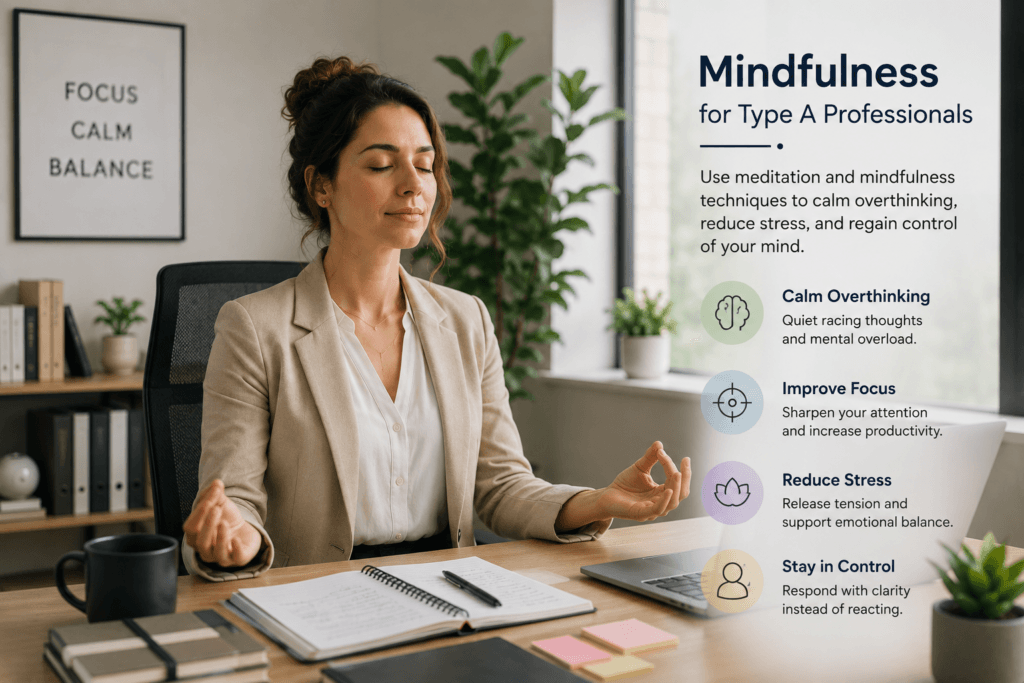
Why Mindfulness for Type A Personality Works (When Nothing Else Does)
Most stress-reduction approaches fail Type A people for one of two reasons: they feel passive (breathing exercises that seem like doing nothing) or they feel unproductive (relaxation techniques that conflict with the drive to optimize). Mindfulness sidesteps both objections — but only if it is framed correctly.
The Neuroscience Type A People Respond To
Dr. Sara Lazar’s 2011 research at Harvard Medical School found that eight weeks of mindfulness practice produced measurable cortical thickening in the prefrontal cortex — the region governing attention, decision-making, and impulse control — and reduced gray matter density in the amygdala, the brain’s threat-detection center. For a Type A person, this translates directly: sharper focus, better decisions, and fewer false alarms from an overactive stress response.
A 2014 meta-analysis published in JAMA Internal Medicine, reviewing 47 clinical trials, found that mindfulness meditation produced moderate-to-strong effects on anxiety, depression, and pain — effects comparable to antidepressant medication for stress-related conditions, without side effects. These are not soft outcomes. They are measurable biological and psychological changes that directly address the chronic activation state most Type A individuals live in.
What Mindfulness Actually Does to Overthinking
Overthinking is a failure of attentional regulation — the mind generates thought loops that the person cannot disengage from. Mindfulness specifically trains the neural circuits responsible for attentional disengagement: the ability to notice a thought, recognize it as a thought (not a fact), and redirect focus intentionally.
This is not passive acceptance. It is an active cognitive skill. And for Type A individuals who have built careers on developing skills, framing mindfulness as a trainable cognitive capacity — rather than a mood or a philosophy — makes it immediately more accessible.
Mindfulness Practices That Fit the Type A Mind
Not all mindfulness techniques work equally well for Type A personalities. Practices that feel formless, time-unlimited, or without measurable progress tend to generate the very frustration they are designed to resolve. The following are specifically suited to the Type A profile.
1. Timed, Structured Meditation
Ambiguity is a Type A stressor. A 10-minute, app-guided meditation session with a defined start and end outperforms open-ended “meditate until you feel calm” instructions for high-achievers every time. Apps like Waking Up (designed by neuroscientist Sam Harris) and Insight Timer offer structured programs with measurable progress tracking — a design that speaks directly to the Type A need for visible achievement.
Starting protocol:
- 10 minutes in the morning, before checking email or news
- Use a guided body scan or breath-focus session
- Track streak and duration — gamify the habit without shame-spiraling if you miss a day
2. Movement-Based Mindfulness
Many Type A individuals find seated meditation intolerable initially. Movement-based mindfulness — running, swimming, or strength training performed with deliberate attention to physical sensation rather than performance metrics — activates the same attentional circuits as seated practice.
The key distinction: movement-based mindfulness requires that you remove earbuds, put away performance data (pace, heart rate), and direct full attention to proprioceptive sensation — breath, muscle engagement, foot contact with the ground. Performance tracking re-engages the evaluative mode that mindfulness is designed to interrupt.
3. Cognitive Defusion Techniques
Drawn from Acceptance and Commitment Therapy (ACT), cognitive defusion is particularly effective for Type A overthinking. The technique involves observing thoughts as mental events rather than facts — creating psychological distance through language shifts:
- Instead of “I am overwhelmed,” say “I am having the thought that I am overwhelmed.”
- Instead of “I will fail,” say “My mind is generating a failure prediction.”
This is not positive thinking. It is accurate thinking: recognizing that a thought is a neural event, not a verdict. Research by Dr. Steven Hayes at the University of Nevada — the founder of ACT — consistently shows that defusion reduces the behavioral impact of negative thoughts more effectively than thought suppression or positive reframing.
4. Meditation for Type A Personality: The 5-4-3-2-1 Grounding Technique
Meditation for Type A personality works best when it involves active sensory engagement rather than passive observation. The 5-4-3-2-1 grounding technique — widely used in trauma-informed therapy — adapts well to high-stress, high-cognition profiles:
- 5 things you can see — name them silently
- 4 things you can physically feel — your feet on the floor, the weight of your hands, air temperature
- 3 things you can hear — background sounds, not narrative about them
- 2 things you can smell — if nothing is present, recall a scent
- 1 slow breath — inhale 4 counts, exhale 6 counts
This technique activates sensory cortical networks and interrupts the default mode network (DMN) — the brain system responsible for self-referential thought and rumination. It takes approximately 90 seconds and can be performed in any environment.

Benefits of Mindfulness for Type A Personality
Performance Benefits
- Improved decision quality — Reduced amygdala reactivity means fewer emotionally-driven decisions under pressure
- Enhanced focus — Prefrontal cortical thickening directly improves sustained attention and task-switching efficiency
- Faster recovery from setbacks — Mindfulness practice is associated with shorter cortisol recovery curves after stressful events
- Reduced perfectionism-paralysis — Defusion techniques interrupt the “not good enough” loops that delay completion
Health Benefits
- Reduced cardiovascular risk — Directly relevant given the original Friedman-Rosenman findings linking Type A behavior to heart disease
- Lower baseline cortisol — Chronic cortisol elevation accelerates cellular aging; mindfulness measurably reduces it
- Improved sleep quality — Rumination is the leading cause of sleep-onset insomnia; mindfulness addresses the root mechanism
- Reduced inflammatory markers — A 2016 study in Biological Psychiatry found mindfulness training reduced expression of pro-inflammatory genes
Pros and Cons for Type A Personalities
| Pros | Cons |
|---|---|
| Measurable, trackable results align with Type A values | Initial practice feels unproductive — expect resistance |
| Improves the performance metrics Type A individuals care about | Requires consistent practice; sporadic use yields little benefit |
| Directly targets overthinking and rumination | Some techniques (open-ended sitting) may not suit Type A style |
| No equipment required, fits into existing high-performance routines | May initially increase awareness of stress before reducing it |
| Research base is robust and clinically validated | Competitive Type A tendencies can corrupt practice (“I’m better at meditating than you”) |
Expert Perspective
Dr. Herbert Benson, founder of the Mind/Body Medical Institute at Harvard Medical School and author of The Relaxation Response (1975), made a career of translating contemplative practice into clinical language for exactly the population that resists it. His central finding — replicated across decades of research — is that the physiological stress response can be reliably counteracted through a learned, elicitable “relaxation response” that mindfulness practice directly activates.
Benson specifically noted that Type A patients were the most resistant to relaxation-based interventions and, when they committed, the most transformed by them. “The people who need this most,” he observed in clinical interviews, “are the people most certain they don’t have time for it.”
Dr. Jon Kabat-Zinn, whose MBSR program has enrolled hundreds of thousands of participants across clinical and corporate settings, makes a similar observation in Full Catastrophe Living: the high-achievers who come to mindfulness as a last resort — after stress has produced physical symptoms — consistently report that it changes not just their health, but their entire relationship to performance. They do not achieve less. They achieve better, and at lower physiological cost.
Practical Daily Schedule for Type A Practitioners
| Time | Practice | Duration |
|---|---|---|
| Morning (before devices) | Guided breath meditation | 10 minutes |
| Mid-morning transition | 5-4-3-2-1 grounding | 90 seconds |
| Lunch break | Mindful eating (no screens) | 15 minutes |
| Pre-meeting | Single conscious breath + body scan | 60 seconds |
| Evening | Cognitive defusion journaling | 5–10 minutes |
| Before sleep | Body scan meditation | 10 minutes |
Total daily investment: approximately 45 minutes. Research by Kabat-Zinn and colleagues shows that 40–45 minutes of daily practice produces the cortical changes documented in the Harvard studies within eight weeks.

Mindfulness for Type A personality is not a retreat from ambition — it is an upgrade to the operating system running it. The science is unambiguous: chronic stress, overthinking, and unregulated cortisol do not make Type A individuals more productive. They make them faster at making worse decisions. Mindfulness directly addresses the neurological mechanisms behind both — with a research base, a measurable timeframe, and techniques that can be adapted to the realities of a high-performance life. Meditation for Type A personality works best when it is treated not as a spiritual practice but as a cognitive performance tool. Start with 10 minutes. Track it. Give it eight weeks. The data will do the rest.
Frequently Asked Questions
Yes, and the research is particularly compelling for this group. Type A individuals experience higher baseline cortisol, greater amygdala reactivity, and more frequent rumination than the general population — all of which mindfulness practice directly targets. Dr. Sara Lazar’s Harvard research found measurable brain structure changes within eight weeks of practice, and a 2014 meta-analysis in JAMA Internal Medicine confirmed mindfulness produces effects on anxiety and stress comparable to medication. The key is choosing structured, outcome-trackable practices rather than open-ended approaches that conflict with the Type A need for visible progress.
The same traits that drive Type A success — urgency, efficiency, the inability to tolerate perceived waste — make unstructured sitting feel counterproductive. The mind interprets stillness as falling behind. The most effective adaptation is to reframe meditation for Type A personality as cognitive training rather than relaxation: a skill-building practice with measurable neurological outcomes, tracked progress, and a defined time commitment. Guided, app-based practices with session logging tend to outperform instruction-only approaches for this population.
Research protocols consistently show measurable changes within 8 weeks of daily practice at 40–45 minutes per day. For more modest but still clinically significant effects, 10–20 minutes of daily structured mindfulness produces reduced cortisol and improved attentional regulation within 4 weeks. The critical variable is consistency, not session length. Daily 10-minute sessions outperform weekly 60-minute sessions in every study comparing frequency versus duration.
Structured, time-bounded practices work best: guided breath meditation, body scan, and cognitive defusion exercises from ACT (Acceptance and Commitment Therapy). Movement-based mindfulness — performed without performance data — is also highly effective for individuals who find seated practice intolerable initially. Open-ended, formless meditation tends to generate frustration in Type A individuals at the beginning of practice. Starting with guided, app-based programs provides the structure and progress visibility that makes the habit sustainable.
Yes. Overthinking is technically a failure of attentional disengagement — the default mode network (DMN) continues generating self-referential thought loops that the person cannot exit voluntarily. Mindfulness practice specifically trains the neural circuits responsible for interrupting DMN activation. Dr. Susan Nolen-Hoeksema’s research on rumination found that mindfulness-based interventions are among the most effective treatments for pathological overthinking — more effective than distraction strategies or positive reframing, which address the content of thoughts rather than the underlying attentional mechanism.