Parents Arguing: How It Affects Children’s Mental Health

Parents Arguing: How It Affects Children’s Mental Health and Emotional Security
Parents arguing is one of the most common sources of stress for children in families worldwide. Most parents disagree at some point — conflict is a normal part of any relationship. However, the way parents argue, how often it happens, and whether children witness it directly all have measurable effects on children’s development. Research consistently shows that how fighting affects a child depends more on the quality and pattern of conflict than on the fact of conflict itself. This article explains what the science says, what children actually experience, and what parents can do about it.
What Research Says About Parents Arguing
The impact of parental conflict on children is one of the most studied areas in developmental psychology. The findings are consistent across decades of research.
The Key Studies
Dr. E. Mark Cummings at the University of Notre Dame has conducted landmark research on how parental conflict affects children. His work shows that children are highly sensitive emotional barometers. Even when parents believe their children are not affected — or not listening — children register the emotional atmosphere of the home at a neurological level.
What matters most for children is not whether parents stay together but how they handle conflict. Households that separate calmly tend to do better by their children than households that stay together and fight.
Not All Conflict Is Equal
It is important to be clear: not all conflict harms children. Research by Dr. Cummings distinguishes between destructive and constructive conflict. Destructive conflict involves:
- Personal attacks and name-calling
- Stonewalling or complete emotional withdrawal
- Physical intimidation or aggression
- Involving children in disputes
- Unresolved, ongoing hostility
Constructive conflict, on the other hand, involves disagreement handled with mutual respect, emotional regulation, and visible resolution. Children who witness constructive conflict can actually develop stronger emotional skills. Therefore, the goal is not to eliminate conflict — it is to manage it well.
How Fighting Affects a Child: The Developmental Impact
Understanding how fighting affects a child across different ages helps parents respond appropriately.
Infants and Toddlers (Ages 0–3)
Children register hostility far earlier than adults assume. Babies react to angry tones of voice long before they understand a word of what is being said, and often while apparently asleep.
As a result, frequent exposure to parents arguing during infancy can:
- Disrupt sleep and feeding patterns
- Increase fussiness and difficulty self-soothing
- Create an insecure attachment bond with caregivers
- Elevate baseline stress hormones during a critical developmental window
School-Age Children (Ages 6–12)
Children in the primary-school years commonly assume the anger will eventually reach them, whatever it is currently about. That belief is rarely spoken aloud and it shapes an enormous amount of their behaviour at home.
As a result, these children often show:
- Increased anxiety and worry
- Difficulty concentrating at school
- Behavioural problems or withdrawal
- Physical symptoms like headaches and stomach aches
- A compulsive sense of responsibility to fix the conflict
Adolescents (Ages 13–18)
Teenagers who grow up in a home with sustained, unresolved conflict are more likely to:
- Develop anxiety and depressive disorders
- Experience difficulties in their own romantic relationships
- Engage in risk-taking behaviour as a coping mechanism
- Show lower academic performance and motivation
- Struggle with emotional regulation and impulse control
The Emotional Security Theory
Dr. Cummings and his colleague Dr. Patrick Davies developed Emotional Security Theory (EST) to explain why parental conflict affects children so profoundly.
What Emotional Security Means
According to EST, children’s primary goal in the family environment is to maintain a sense of emotional security. When parents argue — especially with hostility and no resolution — children perceive the family unit as unstable and unsafe. Therefore, they devote cognitive and emotional resources to monitoring family stress rather than to learning, play, and development.
The Vigilance Cost
This vigilance is exhausting. Children who live in high-conflict homes are often in a state of chronic low-grade hyperarousal. Their nervous systems stay alert for the next conflict. As a result, they may appear anxious, clingy, or irritable — not because of temperament, but because of environment.
What Parents Can Do: Practical Strategies
The research on how fighting affects a child also points clearly toward solutions. These strategies make a measurable difference.
Strategy 1: Resolve Conflict Out of Sight
Not all conflict can be avoided. However, parents arguing in front of children — especially with elevated volume or personal attacks — significantly increases harm. Commit to:
- Moving heated discussions to a private space
- Pausing arguments when children are present
- Never using children as messengers or referees
- Returning to the argument only when both parties are calmer
This does not mean hiding conflict entirely. Children can sense tension regardless. However, limiting their direct exposure to hostility reduces the neurological impact significantly.
Strategy 2: Repair and Resolve Visibly
If children witness conflict, visible resolution is essential. Research by Dr. Cummings found that children who see their parents argue and then make up show fewer emotional problems than children who see only the argument.
Effective repair behaviours include:
- Apologising to each other in front of children
- Showing physical warmth — a touch, a smile — after a disagreement
- Briefly acknowledging to children that adults sometimes disagree, and that it’s okay
- Demonstrating that the relationship is stable even after conflict
Strategy 3: Validate Children’s Feelings
Children who experience parents arguing need explicit reassurance. However, vague reassurance (“Everything is fine”) is less effective than specific validation.
Try these approaches:
- “You might have heard us arguing. That wasn’t your fault.”
- “Adults sometimes disagree. We are both still here and we both love you.”
- “It’s okay to feel worried when you hear us argue. Do you want to talk about it?”
Additionally, avoid asking children to take sides, report on the other parent, or keep secrets about conflict. These behaviours significantly increase psychological harm.
Strategy 4: Model Emotional Regulation
Children learn emotional regulation primarily by watching their caregivers. Therefore, how parents manage their own anger directly shapes how children will manage theirs.
Practical regulation tools:
- Use a 20-minute cooling-off period before discussing heated topics
- Practice slow breathing before difficult conversations
- Name your own emotions aloud in low-stakes moments: “I’m feeling frustrated right now, so I’m going to take a minute.”
- Apologise when you handle conflict poorly — in front of your children when appropriate
Strategy 5: Seek Professional Support Early
Parents arguing at a frequency or intensity that causes visible distress in children is a signal to seek support. This is not a sign of failure. Instead, it is an act of parental responsibility.
Helpful resources include:
- Couples therapy focused on conflict resolution skills
- Co-parenting therapy for separated or divorcing parents
- Child therapy or school counselling if a child shows distress signals
- Family therapy to address patterns involving all members
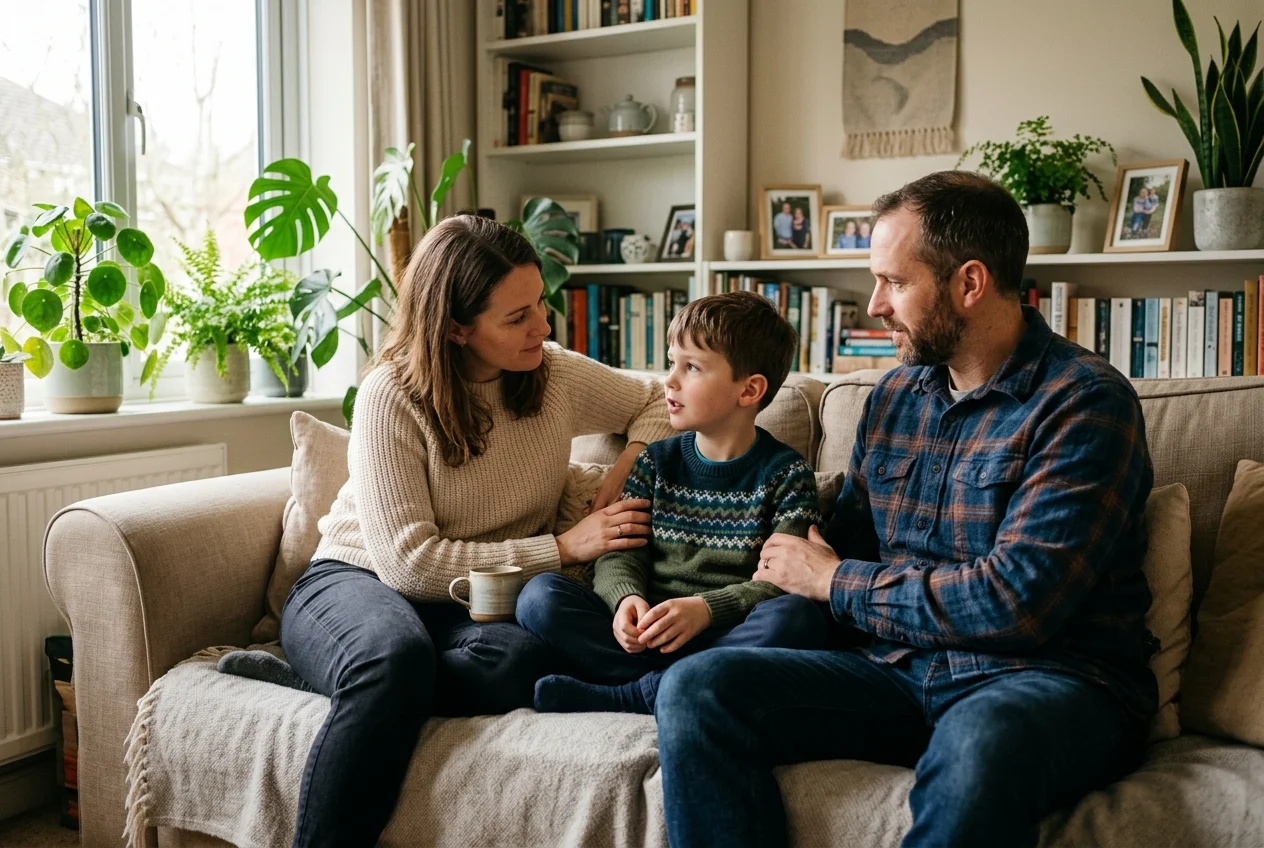
Expert Perspective: Dr. John Gottman on Conflict and Children
What decades of work on couples has made clear is that it is not the presence of conflict that harms children — it is conflict that goes unresolved, and that they never see repaired.
The Four Horsemen
Gottman’s research identifies four conflict patterns that predict the worst outcomes for both couples and children. He calls them the “Four Horsemen”:
- Criticism — Attacking character rather than behaviour
- Contempt — Treating a partner with disrespect or mockery
- Defensiveness — Refusing to accept responsibility
- Stonewalling — Complete emotional shutdown and withdrawal
Children exposed to these patterns regularly internalise them as templates for their own future relationships. Therefore, the impact of parents arguing extends far beyond childhood.
What Gottman Recommends
Gottman’s antidotes are direct and learnable:
- Replace criticism with a “gentle start-up” — describing feelings without blame
- Replace contempt with a culture of appreciation and respect
- Replace defensiveness with shared responsibility
- Replace stonewalling with self-soothing and return to dialogue
These skills are teachable. Furthermore, they do not require conflict to disappear. They require it to be handled differently.
Key Insights at a Glance
Signs a Child Is Affected by Parental Conflict
Look for these signals:
- Sleep disturbances or frequent nightmares
- Regression to earlier behaviours (bedwetting, thumb-sucking)
- Withdrawal from friends and activities
- School performance declining unexpectedly
- Increased aggression or emotional outbursts
- Physical complaints without medical cause
- Excessive worry about parents’ wellbeing
What Protects Children
Research identifies these as the strongest protective factors:
- A warm, secure relationship with at least one parent
- Visible conflict resolution and repair
- Explicit verbal reassurance after arguments
- Age-appropriate explanations about family conflict
- Access to a trusted adult outside the family (teacher, counsellor, grandparent)
Parents arguing is not automatically harmful — conflict is an inevitable part of family life. However, the pattern, intensity, and resolution of that conflict directly shapes a child’s emotional security, mental health, and development. How fighting affects a child depends most on what happens after the argument: whether repair follows rupture, whether children receive reassurance, and whether parents model the emotional skills they want their children to develop. The most important message from decades of research is hopeful: change is possible, and even small improvements in how parents manage conflict produce measurable benefits for children. Therefore, seeking support is not weakness. It is one of the most important things a parent can do.
The Part That Changes Everything: Repair
If you take one thing from this article, take this. Children are not harmed by seeing disagreement. They are harmed by seeing conflict that never visibly resolves.
A child who watches two parents disagree, and then later watches them be warm with each other again, learns something genuinely valuable: that conflict is survivable and relationships recover. A child who only ever sees the argument — because the making-up happens behind a closed door, or over text, or not at all — learns that anger is an ending.
So the practical instruction is unglamorous: repair where they can see it. Not a staged performance and not a speech. A hand on a shoulder in the kitchen, a normal conversation about dinner, someone saying "sorry about earlier" within earshot. Thirty seconds of visible warmth does more work than an hour of careful explanation afterwards.
What to Say Afterwards
Children fill silence with their own explanation, and their explanation is almost always that it was about them. A short, plain sentence prevents that.
- Name it: "You heard us arguing. We were." Denying it teaches them not to trust what they perceive.
- Remove them from it: "That was between me and your dad. It wasn't about you and it wasn't your fault."
- Show it ended: "We've sorted it out. We're okay."
- Leave the door open: "You can ask me about it if you want." Then let them not ask, which most will.
Four sentences. Do not explain the substance of the argument, do not ask them to take a side, and do not apologise at length — extended apology asks the child to reassure the adult, which reverses the roles and adds to what they are carrying.
What Gets Hard, and What to Do About It
The argument happens before you can stop it
Of course it does. Nobody schedules these. The available move is not prevention but interruption: agree in advance on a word or phrase either of you can say to pause things until the children are in bed. Agreeing on it while calm is what makes it usable while not.
You cannot repair because it is not resolved
Repair is not resolution. You can be visibly civil, even warm, about ordinary things while the disagreement is still live. What the child needs to see is that the relationship continues — not that everyone agrees.
Your child says they did not hear anything
They heard. Children routinely say nothing to avoid making it worse. Say your four sentences anyway, briefly, and let them shrug it off — the point is that the explanation is now available to them rather than left to their imagination.
One parent will not participate
Then do your half. A single calm, honest adult who names things and stays steady is a substantial protective factor on their own. You cannot control the other person's behaviour and you can be reliably one thing.
You are the one who cannot stay calm
Worth treating as a practical problem rather than a character flaw. A short daily practice makes the gap between trigger and response wider, and that gap is where all of this happens — the breathing exercises guide has the fastest tools, and the STOP method is designed for exactly this moment.
It has been going on for years
Children are considerably more responsive to a changed present than to a perfect past. Starting to repair visibly now changes what they learn from here, and it is worth doing even when it feels late. If the conflict involves intimidation, control or violence, that is a different situation and needs outside support rather than better technique.
Disagreement itself is not the harmful part — unresolved conflict is. Children who see parents disagree and then see them be warm with each other again learn that conflict is survivable. Children who only ever see the argument learn that anger is an ending.
Four short sentences: name that it happened, make clear it was between the adults and not their fault, say that it is sorted out, and offer that they can ask about it. Do not explain the substance, ask them to take a side, or apologise at length.
The risk of arguing entirely out of sight is that children see the tension without ever seeing the recovery. Heated arguments are better paused until they are in bed, but ordinary disagreement followed by visible repair is genuinely useful for them to witness.
Repair is not the same as resolution. You can be visibly civil and even warm about ordinary things while the disagreement is still unresolved. What a child needs to see is that the relationship continues, not that the adults now agree.
Often not. Children frequently say nothing to avoid making things worse, and younger ones react to angry tones of voice long before they understand the words. Offer the short explanation anyway and let them shrug it off — what matters is that they are not left to supply their own.
Frequently Asked Questions
Does parents arguing always harm children?
Not necessarily. Research by Dr. E. Mark Cummings distinguishes between destructive and constructive conflict. Destructive conflict — involving hostility, personal attacks, and no resolution — consistently harms children. However, constructive conflict — handled with respect and visible resolution — can actually model healthy disagreement skills. Therefore, the goal is not to eliminate conflict but to manage it in ways that maintain children’s sense of emotional security.
At what age are children most affected by parents arguing?
Exposure in the earliest years appears to matter most, because that is when a child is forming their basic expectations about whether the people around them are safe.
How do I know if my child is affected by our arguing?
Look for changes in behaviour, sleep, school performance, or mood. Specifically, watch for withdrawal, increased anxiety, physical complaints without medical cause, regression to younger behaviours, or a compulsive need to mediate between parents. Additionally, children may not always express distress verbally. Therefore, consistent, calm check-ins — not interrogations — give children the space to share what they feel when they are ready.
What should I say to my child after parents arguing in front of them?
Be direct and reassuring. Tell your child the argument was not their fault. Confirm that both parents are okay and that the relationship is stable. For example: “You heard us argue. That was between us, not about you. We both love you very much.” Additionally, validate their feelings: “It’s okay to feel worried or upset. Do you want to talk about it?” Avoid minimising their experience or pretending the argument didn’t happen.
When should parents seek professional help for conflict?
Seek professional support if conflict is frequent, intense, or causing visible distress in your child. Additionally, seek help if arguments involve physical aggression, if children are being drawn into disputes, or if the conflict is affecting your own mental health. Couples therapy, co-parenting therapy, and family therapy are all effective options. Furthermore, child therapy can help a child process the impact of conflict they have already experienced.
If you or your child are experiencing the effects of a high-conflict home environment and need immediate support, please contact a mental health professional. In the US: SAMHSA Helpline 1-800-662-4357 | In the UK: Family Lives Helpline 0808 800 2222.
Keep reading

The 7 Stages of Emotional Healing: A Practical Guide
What happens at each stage, where meditation genuinely helps, and the flat middle stage that makes most people quit.

Inner Child Healing: How to Start, Without the Woo
The signs an old pattern is running your reactions, six practices that work, and when to stop and see a therapist instead.

What to Be Grateful For: How Gratitude Improves Mental Health
What to Be Grateful For: How Practicing Gratitude Can Improve Your Mental Health and Happiness Knowing what you are…