What to Be Grateful For: How Practicing Gratitude Can Improve Your Mental Health and Happiness
Knowing what you are truly grateful for — and taking a moment to feel it — can change the way your brain processes the world around you. That is not motivational language. It is measurable neuroscience. Studies consistently show that people who actively practice gratitude experience less anxiety, sleep better, feel more connected to others, and report significantly higher levels of daily happiness.
The challenge is that most people wait for big things to feel grateful for. A promotion. A vacation. A major life milestone. However, the real power of gratitude lives in the small, ordinary moments hiding in plain sight every single day.
This article will show you exactly what to be grateful for — and how to make that practice work in your real, daily life.
Why Gratitude Has Such a Powerful Effect on the Mind
Gratitude is not just a feel-good concept. It physically changes the brain.
When you consciously focus on what you are grateful for, your brain releases dopamine and serotonin — the neurotransmitters most closely linked to feelings of well-being and emotional balance. Over time, this rewires your neural pathways to scan for positive experiences more naturally.
Dr. Robert Emmons, professor of psychology at UC Davis and the world’s leading scientific expert on gratitude, has spent decades studying this effect. His research found that people who regularly wrote about things they were grateful for reported 25 percent higher life satisfaction than those who focused on daily problems or neutral events.
Additionally, brain imaging studies show that gratitude activates the medial prefrontal cortex — the region associated with moral reasoning, empathy, and reward. In short, feeling grateful does not just lift your mood. It strengthens the part of your brain that helps you connect with others and make better decisions.
Gratitude and the Nervous System
Here is something most people do not realize. Gratitude directly calms your nervous system.
When you feel stressed or anxious, your body activates its fight-or-flight response. Your heart rate increases. Your breathing shortens. Your muscles tense. However, when you shift attention to something you genuinely appreciate — even something small — your parasympathetic nervous system activates. This is your body’s natural rest-and-digest mode.
In practical terms, a 60-second gratitude pause can shift you from a state of stress to one of calm. That is a tool worth having.
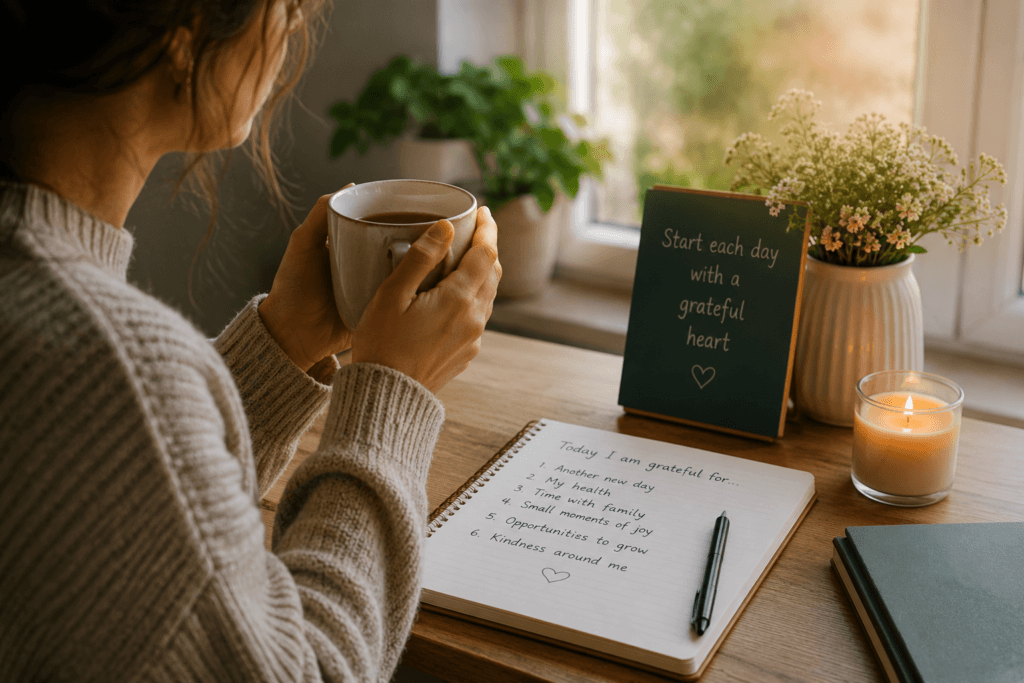
What Are You Grateful For? Simple Things That Matter Most
One of the biggest misconceptions about gratitude practice is that you need remarkable things in your life to feel grateful for. You do not.
Research shows that appreciation for small, everyday experiences produces the same neurological benefits as gratitude for major life events — sometimes more, because small joys are more frequent and therefore more powerful when noticed consistently.
Here are meaningful categories to explore:
Physical Experiences Worth Noticing
- The warmth of sunlight on your face
- A hot shower at the end of a long day
- Waking up without pain
- The smell of coffee in the morning
- A comfortable bed and a safe place to sleep
Relationships and Human Connection
- A friend who checks in on you
- A stranger who smiled at you today
- A pet who greets you at the door
- A family member you can call when things feel hard
- Someone who listened without judgment
Personal Strengths and Inner Resources
- Your ability to keep going during difficult times
- A skill you have quietly developed over the years
- Your capacity to feel empathy for others
- The courage it takes to try new things
- Your body’s ability to heal and recover
Small Daily Freedoms
- Having a choice about what to eat today
- Access to clean water
- The ability to step outside and breathe fresh air
- Books, music, or podcasts that bring comfort
- A moment of quiet in an otherwise busy day
When you regularly acknowledge what you are grateful for in these categories, gratitude becomes less of a practice and more of a lens — one that reshapes how you experience ordinary life.
How to Start a Gratitude Practice That Actually Sticks
Knowing what to be grateful for is one thing. Building a consistent habit around it is another. Here is a practical, beginner-friendly approach.
The 3-Item Gratitude Method
Each morning or evening, write down three specific things you feel grateful for. The key word is specific. Instead of writing “I’m grateful for my family,” write “I’m grateful that my sister texted me this morning just to say she was thinking of me.”
Specificity matters because vague gratitude stays in your head. Specific gratitude lands in your body.
Keep a Gratitude Journal
A gratitude journal does not need to be elaborate. A basic notebook works perfectly. What matters is consistency — returning to it daily, even when it feels difficult or repetitive.
Research published in the Journal of Positive Psychology found that people who kept a gratitude journal for just three weeks reported significantly greater optimism, life satisfaction, and motivation than a control group. Additionally, they exercised more and visited their doctors less frequently.
The act of writing what you are grateful for anchors the feeling in a way that simply thinking about it does not.
Try a Gratitude Meditation
Sit quietly for five to ten minutes. Close your eyes. Bring to mind one person, place, or experience you genuinely appreciate. Let the feeling settle in your chest. Breathe slowly.
This practice combines the calming effect of breath-focused meditation with the neurological benefits of gratitude. Many people find it easier to fall asleep after an evening gratitude meditation, because the nervous system enters the session already in a calm, receptive state.
Signs That Gratitude Practice Is Working
People often expect gratitude to produce dramatic, instant shifts. However, the changes are usually subtle and cumulative. Here is what to watch for:
- You start noticing small pleasures you previously walked past
- You feel less urgency around minor frustrations
- You sleep more easily and wake up less anxious
- Difficult emotions pass through you more quickly
- You feel more connected to the people around you
- You find it easier to encourage others genuinely
These shifts do not happen overnight. However, most people report noticeable changes within two to four weeks of consistent daily practice.
Pros and Cons of Gratitude Practice
Pros
- Free and accessible — requires no tools, apps, or equipment
- Backed by decades of clinical research
- Reduces anxiety and depressive symptoms
- Improves sleep quality
- Strengthens relationships
- Builds emotional resilience over time
Cons
- Can feel forced or hollow at first, especially during difficult periods
- Requires daily consistency to produce lasting effects
- Some people resist the practice if they associate it with toxic positivity
The last point deserves acknowledgment. Gratitude practice does not mean ignoring pain or pretending everything is fine. In fact, the most effective gratitude work happens alongside honest acknowledgment of difficulty — not instead of it.
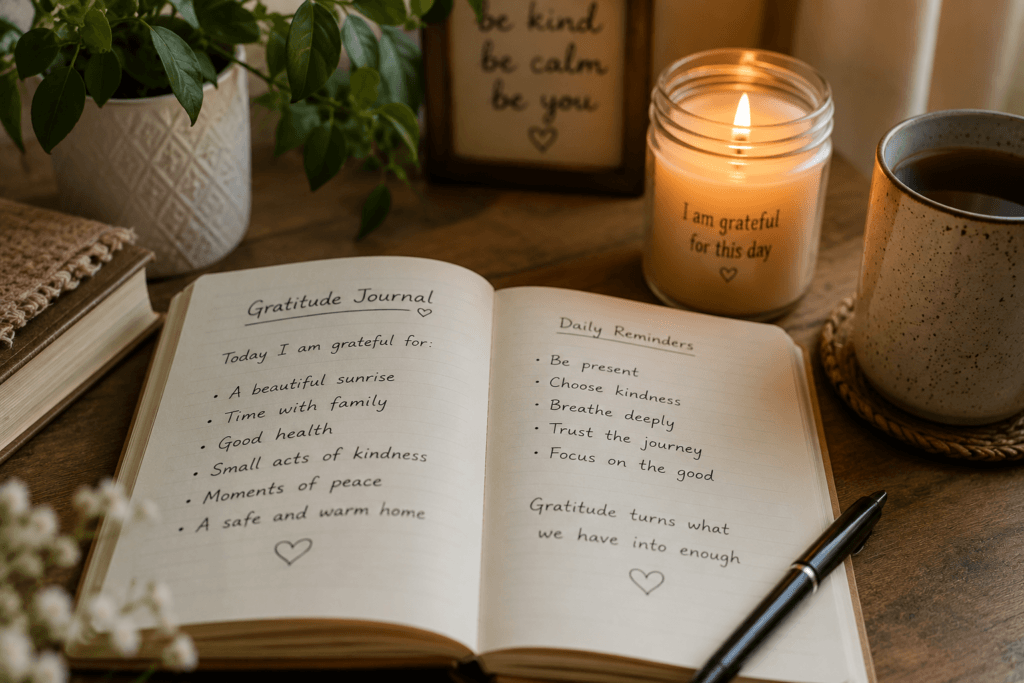
What Experts and Real Practice Tell Us
Dr. Martin Seligman, the founder of Positive Psychology and former president of the American Psychological Association, developed one of the most well-studied gratitude interventions: the Three Good Things exercise. Participants wrote down three things that went well each day for one week, along with a cause for each.
The results were striking. At one-month follow-up, participants showed significantly lower depression scores and higher happiness ratings. At six-month follow-up, many maintained the habit voluntarily — because it worked, and they could feel it.
Meanwhile, clinical therapist and mindfulness teacher Tara Brach notes that gratitude helps dissolve the constant background sense that something is missing or wrong. She describes it as “the antidote to the trance of scarcity” — the belief, often unconscious, that we never have quite enough.
When you train yourself to notice what you are grateful for, you interrupt that trance. And life, as a result, begins to feel fuller.

Gratitude Is a Practice, Not a Feeling You Wait For
You do not need a perfect life to feel grateful for what you have. You need a deliberate practice — one that trains your attention to find the value already present in your days.
Start small. Write three things in a gratitude journal tonight. Choose something specific. Let yourself feel it, even for just a moment. Then do it again tomorrow.
Over time, gratitude stops being something you practice and becomes something you are. And from that place, mental health, happiness, and genuine peace become far more accessible — not because your life changed, but because your attention did.
Frequently Asked Questions
What should I be grateful for when life feels difficult?
During hard times, it helps to focus on the most fundamental things you are grateful for — a safe place to sleep, someone who cares about you, your capacity to breathe and feel. You do not need to be grateful for the difficulty itself. Instead, look alongside it. Even in genuinely painful seasons, small anchors of appreciation exist. Noticing them does not minimize your pain. It simply prevents you from losing sight of what remains.
How does keeping a gratitude journal improve mental health?
A gratitude journal works by training your brain to actively scan for positive experiences rather than defaulting to problems and threats. Research from the Journal of Positive Psychology shows that just three weeks of consistent journaling significantly raises optimism and life satisfaction. Additionally, the act of writing anchors the feeling more deeply than simply thinking it. Therefore, even a few sentences per day can shift your emotional baseline over time.
How long does it take for gratitude practice to show results?
Most people notice subtle but meaningful shifts within two to four weeks of daily practice. However, more significant changes in anxiety levels, sleep quality, and emotional resilience typically emerge after six to eight weeks of consistency. Therefore, the key is not intensity — it is regularity. A short, genuine gratitude practice every day produces far better results than an occasional long session.
Can gratitude help with anxiety and stress?
Yes, and the mechanism is direct. Gratitude activates the parasympathetic nervous system — your body’s calm, rest-and-digest state — which counteracts the fight-or-flight stress response. Additionally, it redirects attention away from anxious future-focused thinking and toward present-moment appreciation. For people experiencing mild to moderate anxiety, a consistent gratitude practice can serve as a powerful daily tool for nervous system regulation and emotional stabilization.
Is gratitude practice the same as ignoring negative emotions?
No. Genuine gratitude practice does not suppress or bypass difficult emotions. Instead, it coexists with them. You can feel grief, frustration, or fear and still find something meaningful to appreciate. In fact, the most effective gratitude work acknowledges difficulty honestly while choosing to also notice what remains good. Forcing positivity over unprocessed pain is counterproductive. However, authentic gratitude — even small and quiet — supports emotional processing rather than hindering it.