Meditation for Burnout: What Helps When You Are Empty

Burnout does not feel like stress. Stress is loud and urgent and makes you work faster. Burnout is quiet: you sit down at your desk, look at a task you could do in twenty minutes, and find that you simply cannot start.
That distinction matters here, because most advice aimed at burnout is really advice for stress — breathe, slow down, take a bath — and it lands badly on someone who is not agitated but flat. If you have tried a meditation app during burnout and found it irritating rather than soothing, that is the reason, and it is not a personal failing.
What follows is meditation adapted for the flat version rather than the frantic one. There is also one honest limitation to state early, because leaving it out is how wellness content becomes part of the problem — and we will get to it before the practices.
Key takeaways
- Burnout is exhaustion plus cynicism plus a sense of ineffectiveness — not simply being very tired.
- Meditation helps you recover capacity. It cannot fix a workload that caused the problem.
- Long still sessions often make burnout worse. Short, physical, eyes-open practices work better.
- The first sign of recovery is usually irritation returning, not calm. That is progress, oddly.
- If you dread Sunday evening every week for months, that is a job problem wearing a wellness costume.
Does Meditation Actually Help With Burnout?
Meditation helps with burnout by restoring some of the capacity that exhaustion has taken — attention, patience, the ability to feel something other than flat. It does not repair the conditions that produced the burnout, and used as a substitute for changing those conditions it tends to delay recovery rather than support it.
That is the honest version, and the limitation promised above. Burnout is generally an occupational phenomenon: it comes from sustained mismatch between what is demanded of you and what you have. No amount of morning practice fixes an understaffed team, and a culture that responds to burnout by offering mindfulness sessions is quietly relocating a structural problem into your personal responsibility.
Which does not make the practice useless. It makes it the right tool for a specific job: getting enough of yourself back to see the situation clearly and do something about it. People deep in burnout frequently cannot tell whether the job is genuinely intolerable or whether they are simply too depleted to judge. A few weeks of short daily practice usually answers that question, and the answer is worth having.
Burnout Is Not Stress, and Not Depression
| Stress | Burnout | Depression | |
|---|---|---|---|
| Energy | Over-engaged, urgent | Disengaged, flat | Flat across everything |
| Emotion | Anxiety, overreaction | Cynicism, numbness | Sadness, hopelessness |
| On holiday | Eases within days | Eases, returns on Sunday night | Travels with you |
| Applies to | Specific demands | Mostly work | Your whole life |
| What helps | Calming the system | Restoring capacity, changing conditions | Professional treatment |
The holiday test is the most useful one in practice. If a week away lifts it and Sunday evening puts it straight back, that is burnout pointing at a situation. If a week away changes nothing at all, and the flatness follows you into things you used to enjoy, please talk to a doctor — that pattern is depression, and it responds to treatment rather than to better routines.

Why Standard Meditation Advice Fails Here
Three specific reasons, all of which people blame themselves for.
Twenty minutes of stillness is too much. Sitting quietly with nothing to do is restful when you have reserves and unbearable when you do not. Depleted people usually fall asleep or become agitated, and both feel like failure.
Turning inward finds nothing pleasant. The instruction to notice how you feel assumes something worth noticing. In burnout what you find is exhaustion and resentment, which is accurate and not soothing.
It becomes another thing to fail at. Adding a daily obligation to a person whose central problem is too many obligations is a poorly designed intervention, however gentle the voice on the recording.
So the version below is deliberately small, physical and unambitious. Nothing here takes longer than five minutes.
Five Practices That Work When You Are Empty
1. Three minutes with your feet
Sit, eyes open, and put your attention on the soles of your feet against the floor. Not the breath — the feet. Three minutes. Feet are neutral territory: they carry none of the emotional freight that the chest and stomach do, which makes them tolerable when turning inward otherwise is not.
2. The doorway breath
One slow breath every time you walk through a door, with a longer exhale than inhale. It costs nothing, it happens a dozen times a day, and it requires no willpower at a point in your life when willpower is the scarce resource. The full set of options is in our breathing exercises guide.
3. Walking with attention
Ten minutes outside, attention on the contact of your feet with the ground and the temperature of the air. Movement suits depleted systems far better than stillness, and being outdoors does a portion of the work by itself. This is the practice to use if you can only manage one.
4. The five-minute body scan, lying down
Feet to head, twenty seconds per region, changing nothing. Do it at lunchtime rather than bedtime — burnout tends to bring an afternoon crash, and this is more useful there than as a sleep aid. The method is covered fully in body scan meditation.
5. One honest sentence
Once a day, name where you actually are, without softening it: I am running on empty and I resent all of it. Naming a state reduces its grip, and burnout in particular is worsened by the effort of pretending to be fine. Thirty seconds, silently, no fixing required.
What Gets Hard, and What to Do About It
You fall asleep every time
Then you are sleep-deprived, not bad at meditating, and the sleep is the more urgent need. Practise sitting up with your eyes open, and treat the sleepiness as information worth acting on rather than an obstacle to push through.
You feel angry when you sit down
Extremely common, and a genuinely good sign. Anger requires more energy than numbness does, so its return usually means capacity is coming back. It also tends to point accurately at what needs to change, which numbness never does.
Five minutes feels like too much to give
Then do one minute, or do the doorway breath and nothing else. The floor matters more than the ceiling here — an absurdly small practice you actually do beats a reasonable one you abandon in week two.
It helps, and nothing changes
Expected, and important to name. If your workload is the cause, feeling slightly better does not remove the cause. Use the recovered capacity for the practical conversation — about scope, hours, or leaving — rather than spending it absorbing more of the same.
You feel guilty taking the time
A near-universal feature of burnout, and worth noticing as a symptom rather than a fact. The belief that you must earn rest is usually part of what got you here. If that belief is loud, the practices in self-compassion address it more directly than any breathing technique.
What Recovery Actually Looks Like
Weeks one and two: very little, and you will conclude it is not working. What usually improves first is sleep, and you may not connect the two.
Weeks three and four: irritation returns. Genuinely a milestone — feeling annoyed requires energy that numbness did not permit, and it is often the first honest signal about what needs to change.
Months two and three: small interests come back. You read something for pleasure, or want to cook rather than order. Cynicism starts to loosen before energy fully returns.
Beyond: recovery from real burnout typically takes months rather than weeks, and it takes considerably longer if the conditions have not changed. That is not a failure of the practice; it is the shape of the thing.
No. Meditation restores some of the capacity exhaustion has taken — attention, patience, the ability to feel something other than flat — but burnout usually comes from a sustained mismatch between demands and resources, and only changing those conditions resolves it. Used as a substitute for that change, it tends to delay recovery.
Short, physical and eyes-open. Three minutes attending to your feet on the floor, one slow breath at every doorway, or ten minutes walking with attention on the ground all work better than long still sessions, which depleted people usually find agitating or simply sleep through.
Because sitting quietly with nothing to do requires reserves you do not currently have, and turning inward finds exhaustion and resentment rather than anything soothing. Switch to shorter, movement-based practices and use a neutral anchor such as your feet rather than the breath or chest.
Burnout usually eases on holiday and returns on Sunday evening, and it is mostly attached to work. Depression travels with you, flattens things you used to enjoy, and does not lift with a week away. If a break changes nothing, speak to a doctor — that pattern responds to treatment rather than to routines.
Months rather than weeks, and considerably longer if the conditions that caused it have not changed. Sleep tends to improve first, irritation returns around weeks three and four — which is progress, since it takes more energy than numbness — and genuine interest in things comes back later.
Spending the Recovered Capacity Well
This is the part that decides whether the practice was worth doing, and it is the part almost every article on this subject leaves out.
When some energy comes back, there is a strong pull to spend it absorbing more work — you feel slightly better, so you take the extra project, and three months later you are back where you started with the added conviction that meditation does not work. It worked. You spent the proceeds on the thing that caused the problem.
A more useful allocation, roughly in order:
- Write down what specifically drains you. Not "my job" — the meeting, the person, the reporting line, the constant availability. Burnout feels total and is usually driven by two or three identifiable things.
- Pick the one that is most changeable. Not the biggest. The one where a conversation could plausibly produce a different arrangement within a month.
- Have that conversation while you still have the capacity for it. Waiting until you feel fully recovered means waiting for something that will not arrive while the conditions hold.
- Frame it as workload, not wellbeing. "I can deliver A and B properly, or A, B and C badly — which do you want?" is a conversation about scope. "I am burnt out" too often gets rerouted to an employee assistance programme and changes nothing.
If that conversation is impossible, or you have had it and nothing moved, that is genuine information rather than a failure on your part. Some situations are not fixable from the inside, and knowing which one you are in is exactly the clarity the practice was for.
Noticing It Earlier Next Time
Burnout has a fairly consistent approach, and the early signs are much easier to act on than the late ones. Most people can recognise their own version in hindsight, which makes it worth naming now.
The usual sequence: first the small pleasures go — you stop cooking, stop reading, stop replying to friends. Then the recovery time lengthens, so a bad Tuesday now costs the whole week rather than an evening. Then comes the cynicism, which feels like clear-sightedness from the inside and is usually the loudest signal to anyone watching. Only after all that does the exhaustion arrive properly.
The practical use of a short daily practice is that it makes stage one visible. Sitting for three minutes and noticing you feel nothing about anything is a data point you would otherwise drive straight past, and stage one is where the cheap interventions still work — a real weekend, a boundary on evening email, one thing removed from the list.
Beyond that, the ordinary protections are unglamorous and effective: sleep treated as non-negotiable, one thing each week that has no purpose at all, and at least one relationship where you are not useful to anybody. If getting there requires being kinder to yourself than currently comes naturally, being kind to yourself without feeling guilty is the place to start.
Start With Your Feet
Not a routine, not an app, not a plan to become someone who meditates. Sit where you are, eyes open, and put your attention on the soles of your feet for three minutes.
That is enough for today, and asking more of a depleted person is how these things fail. When some capacity returns — and it will — spend the first of it on the conversation you have been avoiding rather than on a longer practice. If evenings are the hardest part, evening meditation is a gentler place to put the same five minutes.
Keep reading
How to Stop Focusing on Your Breathing During Meditation
How to Stop Focusing on Your Breathing During Meditation Knowing how to stop focusing on your breathing is one…
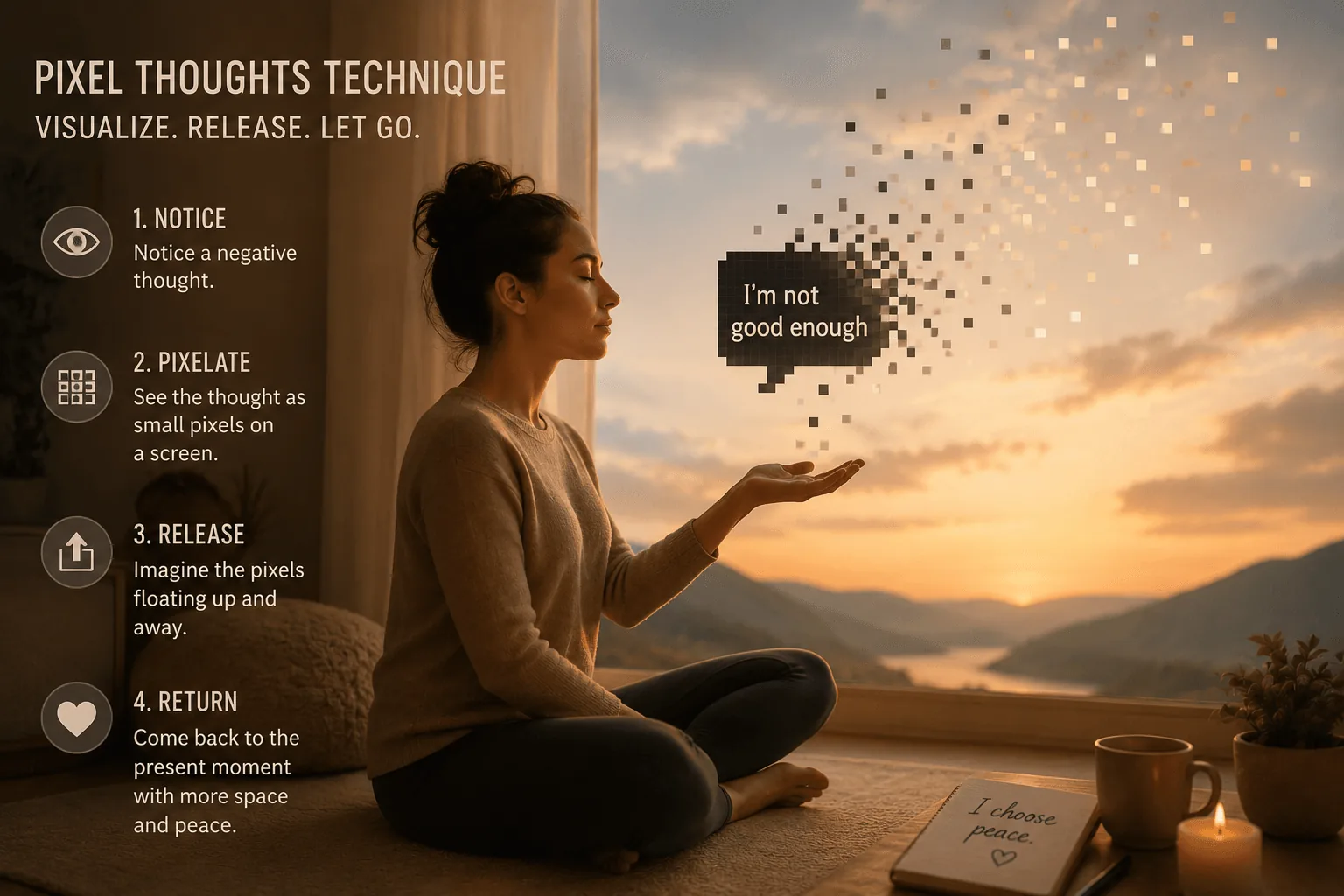
Pixel Thoughts: Let Go of Negative Thoughts With Mindfulness
Pixel Thoughts: How to Let Go of Negative Thoughts and Calm Anxiety Pixel thoughts is a mindfulness-based visualization…
STOP Method: The Mindfulness Technique That Resets Your Mind
The STOP method is a four-step mindfulness intervention designed to interrupt automatic stress responses and return you…