Progressive Muscle Relaxation Script (Read Aloud)

Most people who look for a progressive muscle relaxation script want the actual words, not an explanation of why relaxation is good for them. So the full script is below, written to be read aloud at a slow pace — about fifteen minutes if you do not rush it.
Two things before you start, because they are the difference between this working and this being a slightly odd fifteen minutes. The first is how hard to tense: much less than you think. The second is the part almost every recording gets wrong, and it is not the tensing at all.
Key takeaways
- Tense to about 70 percent, never to the point of pain or cramping.
- Hold for five seconds, release suddenly, then rest for a full twenty. The rest is the exercise.
- Work upward from the feet for sleep; downward from the face for daytime alertness.
- Skip any muscle group that is injured, healing, or painful — there is no requirement to do all of them.
- Record yourself reading it. Your own voice at your own pace beats any app.
What Is Progressive Muscle Relaxation?
Progressive muscle relaxation is a technique in which you deliberately tense one muscle group at a time, hold briefly, then release it completely and notice the contrast. Working through the body group by group teaches you what physical tension actually feels like — and how to let it go on purpose.
It was developed in the 1920s by the physician Edmund Jacobson, which makes it one of the oldest structured relaxation methods still in everyday clinical use. It is taught widely for anxiety, insomnia and tension headaches, usually as part of a broader treatment rather than on its own.
The reason it works for people who cannot meditate is that it gives you something concrete to do. There is no instruction to clear your mind or observe your breath — you squeeze your fist, you let go, you notice. For anyone who finds stillness agitating, that difference is decisive.
The Four Rules That Make It Work
Here are the two things promised at the top, plus two more worth knowing.
Tense to about 70 percent. Not maximum effort. You are creating a noticeable contrast, not testing your grip strength. Squeezing at full force produces cramps, and a calf cramp is a poor start to a relaxation exercise.
The release is instant, the rest is long. This is the part recordings get wrong. Do not ease off gradually — drop the tension all at once, like letting go of a rope. Then do nothing for a full twenty seconds. Most people rush to the next muscle after four. The twenty seconds of noticing is where the technique actually lives; the tensing is only there to make the contrast obvious.
Breathe out as you release. Inhale as you tense, exhale as you let go. It doubles the effect at no extra cost, for the reasons covered in our guide to breathing exercises.
Skip anything that hurts. Injured shoulder, bad back, recent surgery, cramp-prone calves — leave that group out entirely, or simply rest your attention there without tensing. Nothing is lost.
The Full Script
Read this aloud slowly, or record it and play it back. The pauses in brackets are instructions to you as the reader — do not read them out. Lying down is best for sleep; a chair works for daytime.
Settle into a position you can stay in for a while. Let your arms rest at your sides. Close your eyes if that feels comfortable, or let your gaze soften toward the floor.
Take three slow breaths. Let each one out a little longer than it came in. [pause 15 seconds]
We are going to work through the body one area at a time. Each time, you will tighten the muscles for about five seconds, then let go all at once, and rest.
Feet. Curl your toes downward and tighten the arches of both feet. Hold. Two, three, four, five — and release. Let the tension go completely. Notice the difference between how your feet felt a moment ago and how they feel now. [pause 20 seconds]
Lower legs. Point your toes back toward your knees and feel your calves tighten. Gently — these cramp easily. Hold. Two, three, four, five — release. Let your lower legs become heavy. [pause 20 seconds]
Thighs. Press your knees together and tighten the large muscles of both thighs. Hold. Two, three, four, five — and let go. Feel the weight of your legs against what is underneath them. [pause 20 seconds]
Hips and lower back. Squeeze the muscles of your seat and lower back. Hold. Two, three, four, five — release, and let your hips settle. [pause 20 seconds]
Stomach. Tighten your abdomen as though bracing for something. Hold. Two, three, four, five — and release. Let your breathing move your belly freely again. [pause 20 seconds]
Hands. Make a fist with both hands. Firmly, not painfully. Hold. Two, three, four, five — open your hands and let your fingers fall loose. [pause 20 seconds]
Forearms and upper arms. Bend your elbows and tighten your whole arms. Hold. Two, three, four, five — release, and let your arms drop back down, heavy. [pause 20 seconds]
Shoulders. Lift your shoulders up toward your ears. Hold. Two, three, four, five — and let them fall. Let them keep falling, a little further than you expected. [pause 20 seconds]
Neck. Gently press the back of your head down into the surface behind it. Softly. Hold. Two, three, four, five — release. [pause 20 seconds]
Jaw and mouth. Bring your back teeth lightly together and press your lips closed. Hold. Two, three, four, five — release. Let your jaw hang slightly open. Let there be a small gap between your teeth. [pause 20 seconds]
Eyes and forehead. Squeeze your eyes shut and lift your eyebrows at the same time, wrinkling your forehead. Hold. Two, three, four, five — and release. Let your forehead become smooth. Let the skin around your eyes go soft. [pause 20 seconds]
Now stop tensing anything. Take a slow breath and, on the way out, let your whole body sink a little further. [pause 15 seconds]
Scan through quickly from your feet to your head. If you find somewhere still holding on — often the jaw, often the shoulders — simply breathe out and let it soften. You do not need to tense it again. [pause 30 seconds]
Stay here as long as you like. If this is for sleep, stop reading now and let yourself drift. If you are returning to your day, wiggle your fingers and toes, take a fuller breath, and open your eyes slowly.
The Five-Minute Version
For a bad afternoon, a work break, or a night when the full script feels like too much. Four groups instead of eleven, same rules.
| Group | How to tense | Hold | Rest |
|---|---|---|---|
| Both legs | Point toes, tighten thighs together | 5 sec | 20 sec |
| Both arms and hands | Fists, bend elbows, tighten | 5 sec | 20 sec |
| Shoulders and neck | Shrug up toward the ears | 5 sec | 20 sec |
| Face | Squeeze eyes shut, clench jaw lightly | 5 sec | 20 sec |
Four rounds, about five minutes with the rests. If you only ever do the shoulders and the face, you will still get most of the benefit — those two hold the majority of everyday stress tension for most people.
Feet to Head, or Head to Feet?
It matters more than it sounds, and it is the same principle as a body scan.
Feet upward — the version scripted above — draws attention away from the head and toward the body. Use it for sleep and for evening wind-down.
Face downward starts at the most alert end and finishes with your feet on the floor. Use it for a midday reset, before a difficult meeting, or any time you need to be calm but still switched on.
If you have been doing it at bedtime and finding yourself wide awake afterwards, the direction is the first thing to change. The same logic applies to body scan meditation, which is the natural next practice once tensing stops being necessary.
How to Use the Script
Record yourself. The most useful version by a wide margin. Read it into your phone's voice recorder, slowly, with real pauses. Your own voice at your own pace beats any commercial recording, and you will not be interrupted by an advert halfway through your shoulders.
Speak more slowly than feels natural — most people read this about twice too fast on the first attempt. If your recording comes out under ten minutes, the pauses are too short.
Read it to someone else. It works well for a partner who cannot sleep, and for children from around eight upward with the tensing made into a game.
Or just remember the shape. After a week or two most people no longer need the words. Tense, hold five, drop, rest twenty, move up. That is the whole method.
What Gets Hard, and What to Do About It
You get a cramp
Almost always the calves, and almost always from tensing too hard. Drop to about half effort in the legs, or skip them. Cramping is a signal about intensity, not a sign you are doing the sequence wrong.
You cannot tell the difference between tense and relaxed
Common in the first week, particularly for people who have been tense so long it reads as normal. Lengthen the hold to seven seconds and the rest to thirty. The contrast becomes obvious within a few sessions, and that recognition is the real skill being built.
You fall asleep before the end
If it is bedtime, that is the exercise working and there is no need to finish. If you also want the daytime benefits, do a second session sitting up, somewhere that is not your bed.
Your mind wanders the whole way through
Expected, and it matters less here than in most practices — the physical instruction carries you along even when your attention is elsewhere. Notice, return to the next muscle group, carry on. There is nothing to restart.
It makes you more anxious
For some people, particularly with panic, close attention to the body is activating rather than settling. Keep your eyes open, stay sitting up, and use only hands and shoulders for a few minutes. If it is still uncomfortable, an external anchor works better than a physical one — see the 5-4-3-2-1 grounding technique.
You stop after a week
The usual pattern. Attach it to something fixed — getting into bed, or the ten minutes after you close your laptop — rather than to an intention to relax more. The short version counts on busy days.
When to Be Careful
Progressive muscle relaxation is low-risk, and there are a few sensible exceptions.
Skip any area that is injured, healing, inflamed or recently operated on — rest your attention there without tensing, or leave it out. If you have a condition affecting your muscles or nerves, are pregnant, or have high blood pressure or a heart condition, check with your doctor before making it a regular practice, particularly the more forceful tensing.
And the broader point: this is a good tool for ordinary tension, difficulty sleeping and everyday anxiety. It is not a treatment for an anxiety disorder, chronic insomnia or trauma. If anxiety is interfering with your work, sleep or relationships, or if sleep has been poor for more than a few weeks, speak to a doctor — there are established treatments that work well, and this sits alongside them rather than instead of them.
What to Expect, Week by Week
First few sessions: it feels mechanical and slightly silly, and you will probably tense too hard. You may notice you fall asleep faster. Nothing else obvious.
Week two: the contrast between tense and released becomes clearer, and you start catching tension during the day — a clenched jaw at your desk, shoulders around your ears in traffic.
Weeks three and four: you can release a muscle group without tensing it first. This is the real goal: the tensing was only ever the training wheels.
Beyond: most people stop doing the full script and keep a thirty-second version — shoulders, jaw, hands — available whenever they notice they are braced. That is a genuinely useful thing to own.
If tensing and releasing muscles is not for you, the yoga nidra script is the gentler alternative: same position, same length, but nothing to contract — you simply follow your attention around the body.
Work through the body one muscle group at a time. Tense each group to about 70 percent for five seconds while breathing in, release the tension suddenly while breathing out, then rest for a full twenty seconds noticing the difference. Move upward from the feet for sleep, downward from the face for daytime.
The full eleven-group script takes about fifteen minutes read at a proper pace. A four-group short version — legs, arms, shoulders, face — takes five minutes and keeps most of the benefit. If your recording comes in under ten minutes, your pauses are too short.
About 70 percent of maximum — enough to feel a clear contrast, never enough to hurt. Full-force tensing causes cramps, especially in the calves. If you cramp, halve the effort in that area or skip it entirely.
Many people fall asleep partway through, which is a success rather than a failure when sleep is the goal. Work from the feet upward, do it lying down in bed, and do not try to reach the end. For persistent insomnia lasting more than a few weeks, speak to a doctor about established treatments.
Progressive muscle relaxation tenses and releases each area; a body scan only observes it without changing anything. The tensing version suits people who find stillness agitating or who cannot yet feel where they are holding tension. Most people move to the body scan once that recognition develops.
Start With Your Shoulders
If fifteen minutes is more than you have right now, do one group. Lift your shoulders toward your ears, hold for five, and drop them all at once. Then do nothing for twenty seconds.
Most people are surprised by how far they fall. That surprise is the whole point of the method — you cannot let go of tension you did not know you were holding. When you want something quieter to move on to, evening meditation and how to stop overthinking at night are the natural next steps.
Keep reading
How to Stop Focusing on Your Breathing During Meditation
How to Stop Focusing on Your Breathing During Meditation Knowing how to stop focusing on your breathing is one…
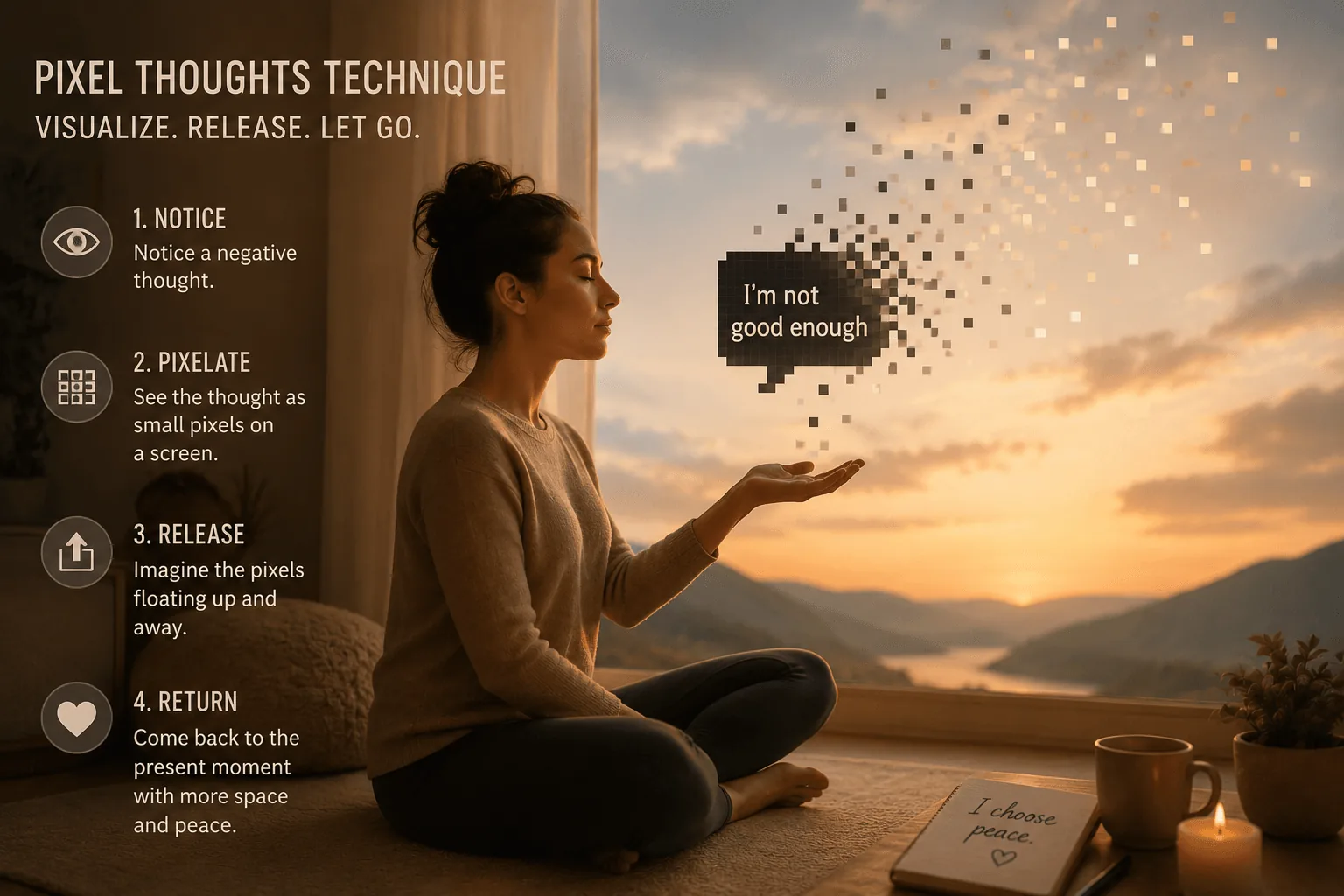
Pixel Thoughts: Let Go of Negative Thoughts With Mindfulness
Pixel Thoughts: How to Let Go of Negative Thoughts and Calm Anxiety Pixel thoughts is a mindfulness-based visualization…
STOP Method: The Mindfulness Technique That Resets Your Mind
The STOP method is a four-step mindfulness intervention designed to interrupt automatic stress responses and return you…