10-Minute NSDR (Yoga Nidra) for Afternoon Burnout: Restoring Dopamine Without Caffeine

Why Afternoon Brain Fog Needs Non-Sleep Deep Rest Instead of Espresso
Quick Answer · Clinical Somatic Reset
Non-Sleep Deep Rest (NSDR), derived from clinical Yoga Nidra, guides the brain from fatigued high-beta waves into restorative alpha and theta states (4–8 Hz) while the body lies completely still. A 10-minute session clears metabolic adenosine buildup and restores striatal dopamine reserves without causing late-day sleep inertia.
At 2:30 PM, your eyes blur over spreadsheets, your working memory stalls, and reaching for a second coffee only gives you a jittery heart rate alongside the same mental exhaustion. Your prefrontal cortex needs a structured downshift into theta frequencies — a pattern that responds rapidly when paired with speed-first meditation for racing thoughts.
Theta-State Synaptic Downscaling and Striatal Dopamine Recovery
Hours of continuous decision-making deplete catecholamines in the prefrontal cortex and accumulate extracellular adenosine, creating the heavy cognitive friction known as afternoon burnout.
By systematically rotating tactile awareness through the motor homunculus (thumbs, fingertips, palms, soles) while lying supine, NSDR slows cortical firing to theta waves (4–8 Hz) and elevates baseline dopamine in the striatum, especially when reinforced by kinetic multi-sensory meditation for an ADHD brain.
The 4-Step 10-Minute Afternoon NSDR Protocol
Step 1: Supine Zero-Gravity Setup (1 Minute)
Lie flat on a sofa, rug, or bed with a thin pillow under your knees and a cloth over your eyes. Let your feet fall naturally outward and turn your palms upward.
Step 2: The 61-Point Homunculus Rotation (4 Minutes)
Without moving a single muscle, shift your tactile attention rapidly from point to point: right thumb, index finger, middle finger, ring finger, little finger, palm, wrist, elbow, shoulder — then repeat on the left side.
Step 3: Heavy-to-Light Somatic Contrast (3 Minutes)
On each exhale, imagine your entire body becoming as heavy as lead sinking into the floor for 90 seconds; then imagine your body becoming weightless like cotton floating a millimeter above the surface.
Step 4: Three-Breath Phased Awakening (2 Minutes)
Deepen your nasal inhale, gently wiggle your fingers and toes, stretch your arms overhead, and roll onto your side before sitting up refreshed.
Troubleshooting Afternoon NSDR & Yoga Nidra
| Obstacle / Symptom | Neurobiological Cause | Immediate Somatic Adjustment |
|---|---|---|
| Falling into deep sleep and waking up groggy | Performing the practice in a warm, dark bed for longer than 20 minutes | Practice on a rug or couch in daylight and set a gentle 12-minute chime so you remain in the alpha-theta borderland |
| Mind starts planning the rest of the workday | Dwelling too long on each body part during rotation | Move your attention from finger to finger every 2 seconds — the brisk pace prevents Default Mode Network wandering |
| Restless urge to move legs during the first 3 minutes | Residual motor cortex arousal from desk work | Perform one 5-second full-body isometric squeeze and release before beginning the rotation of consciousness |
Frequently Asked Questions
Is 10 minutes of NSDR really enough to replace a nap?
Yes. Because NSDR enters alpha and theta brainwaves within three minutes without descending into slow-wave delta sleep, 10 minutes restores alertness without triggering post-nap sleep inertia.
Why does Yoga Nidra focus so much on the hands and fingers?
The hands, fingers, lips, and tongue occupy the largest surface area of the brain's somatosensory homunculus, making finger-by-finger rotation the fastest way to quiet cortical chatter.
Can I do NSDR sitting in an office chair?
Yes. If you cannot lie down, recline slightly with your head supported against a headrest or wall and your hands resting open on your thighs.
What is the difference between meditation and NSDR?
Traditional seated meditation requires active upright attentional effort, whereas NSDR is performed lying down using passive sensory rotation to induce deep autonomic rest.
Clinical References & Studies
- Lehrer, P. M., & Gevirtz, R. (2014). Heart rate variability biofeedback: how and why does it work? Frontiers in Psychology, 5, 756. [Peer-Reviewed / DOI]
- Balban, M. Y., Neri, E., Kogon, M. M., et al. (2023). Brief structured respiration practices enhance mood and reduce physiological arousal. Cell Reports Medicine, 4(1), 100895. [Cell / DOI]
- Porges, S. W. (2007). The polyvagal perspective. Biological Psychology, 74(2), 116-143. [PubMed / DOI]

Julian Vance
Lead Somatic Specialist & Breathwork FacilitatorPractitioner specializing in nervous system regulation, HRV resonance frequency biofeedback, and somatic stress relief for digital workers.
Keep reading

Walking Meditation for ADHD: A 5-Minute Kinetic Focus Protocol When You Can't Sit Still
Walking meditation for ADHD replaces static stillness with rhythmic heel-to-toe plantar proprioception and step-synced breathing.
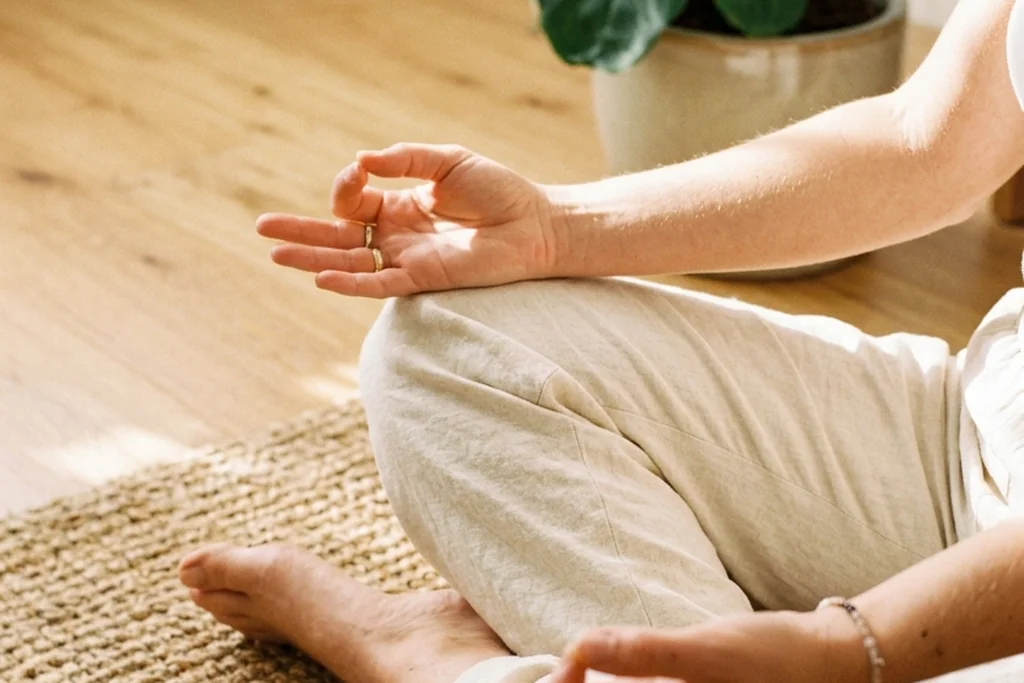
Meditation for an ADHD Brain: Why Sitting Still Fails (And Kinetic Anchors That Work)
Meditation for an ADHD brain requires high-stimulation kinetic or multi-sensory anchors rather than silent breath-watching, which starves an under-stimulated dopamine system.

The S.T.O.P. Method: A 60-Second Cognitive Circuit Breaker for Acute Overwhelm
The S.T.O.P.