Meditation Posture: How to Sit Without Going Numb
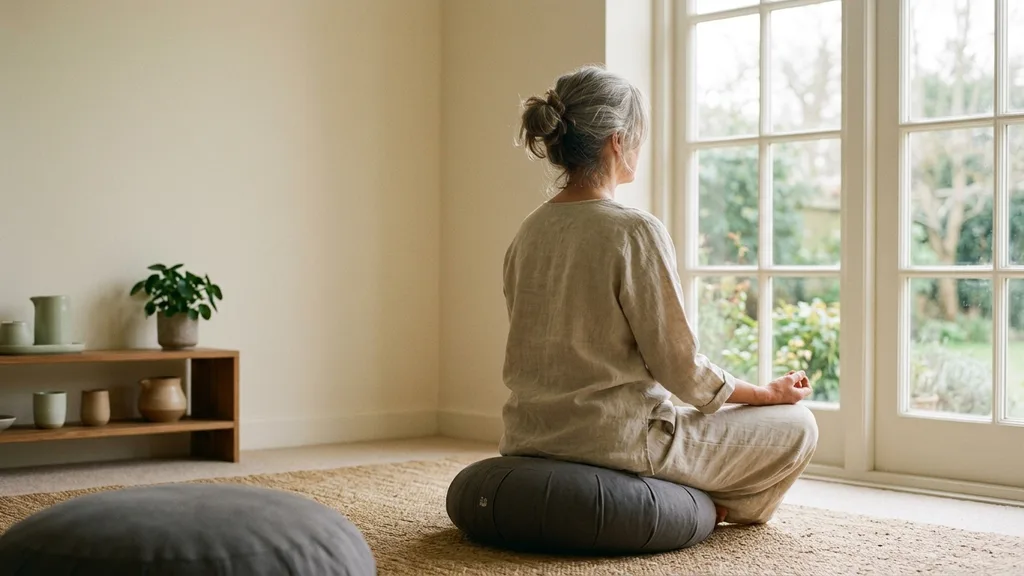
Six minutes in, your left foot is gone. Not painful yet — just absent, the way a limb goes when you have been sitting on it. You shift your weight, the pins and needles start, and whatever you were doing with your attention is now entirely about your foot.
Almost every article about meditation posture is a gallery of positions with Sanskrit names, photographed by people whose hips do not hurt. That is not the problem most people have. The problem is that sitting still is uncomfortable, and nobody explains what to do about it.
So this is a guide to posture as a comfort problem. There is one adjustment that solves most of it, and it has nothing to do with which posture you pick — I will get to it after the postures themselves, because it applies to all of them.
Key takeaways
- A chair is a legitimate meditation posture. It is not the beginner option.
- The spine should be upright and the rest of you should be soft. Most people get this backwards.
- Numb legs are almost always a height problem, not a flexibility problem.
- The classical checklist has seven points, and only two of them are about your legs.
- Change posture when you need to. Sitting through real pain teaches your body that meditation hurts.
What Makes a Good Meditation Posture?
A good meditation posture is one you can hold without effort for as long as you intend to sit. It keeps the spine upright so you stay alert, lets the shoulders, jaw and hands go soft so you can relax, and puts no sustained load on any joint. Which posture achieves that depends entirely on your body, not on tradition.
That is the whole principle, and everything below is detail. Alert spine, soft everything else, no joint under strain. A perfectly executed full lotus that leaves you counting the seconds is a worse posture than slouching slightly in a kitchen chair.
The Seven Points
The classical checklist, usually attributed to the Tibetan tradition, runs through seven parts of the body. It is a genuinely useful way to set yourself up, and notice how little of it concerns your legs.
- Legs — crossed, kneeling, or feet flat on the floor. Whatever you can hold.
- Hands — resting in the lap or on the thighs, one on top of the other or palms down. Not held up, not gripping.
- Spine — upright, with the natural curve at the lower back intact. Tall, not braced.
- Shoulders — rolled back and then dropped. Wide across the collarbones.
- Chin — tucked very slightly, so the back of the neck is long and you are not looking up.
- Jaw and tongue — jaw loose, teeth slightly apart, tongue resting behind the top teeth.
- Eyes — closed, or open and unfocused a metre or two ahead on the floor.
Run through it once at the start and then forget it. It is a setup routine, not something to monitor for twenty minutes.
The Postures, and Who Each One Suits
A chair
Feet flat on the floor, knees roughly hip width, sitting forward enough that you are not leaning on the backrest. If your feet do not reach the floor, put a book under them. If your lower back complains, a small cushion behind it is fine.
This suits almost everyone, works in an office, and carries no risk to your knees. The only reason it has a reputation as the beginner option is that it photographs badly.
Burmese
Sitting on a cushion with both shins on the floor in front of you, one ankle in front of the other, neither leg crossed over the other. The most accessible floor posture by a wide margin, and the one most long-term meditators quietly use.
Seiza, or kneeling
Kneeling with a cushion or a low bench between your heels, so your weight rests on the cushion rather than your feet. Excellent for the spine — it almost forces a good curve — but hard on the ankles and knees for some people. A bench solves this more reliably than a cushion.
Quarter and half lotus
Quarter lotus: one foot rests on the opposite calf. Half lotus: one foot rests on the opposite thigh. Both need a reasonable amount of hip rotation, and both are asymmetrical — swap sides between sessions or you will build a lopsided habit.
Full lotus
Both feet on the opposite thighs. Very stable once you are in it, and available to a small minority of adult bodies without months of preparation. There is no benefit to the practice itself that the other postures do not also provide. Forcing it is a good way to injure a knee, because the rotation has to come from the hip and if the hip will not give, the knee does.
Standing
Feet hip width, knees very slightly unlocked, arms hanging. Useful when you are too restless to sit or too sleepy, and the obvious answer for anyone whose back does not tolerate sitting.
Lying down
On your back, cushion under the knees, arms slightly away from the sides. The most comfortable and the most likely to end in a nap — which is either a problem or the plan. It is the standard position for longer guided practices such as a yoga nidra script or a body scan meditation.
The Adjustment That Fixes Most of It
Get your hips higher than your knees.
That is it. Almost every complaint about floor sitting — numb feet, aching knees, a lower back that gives out at minute eight, the constant urge to lean back — comes from sitting too low.
When your hips are level with or below your knees, your pelvis rolls backwards. Your lower back has to round to compensate, your abdomen compresses, and the fold at your hip crease tightens over the vessels and nerves running down your legs. Then your foot goes to sleep and you conclude you are not flexible enough to meditate.
You are almost certainly flexible enough. You are sitting too low.
Raise yourself until your hips are clearly above your knees and your thighs slope gently downwards. Most people need considerably more height than they expect — a firm cushion, a folded blanket, two folded blankets, or a proper meditation cushion. Height is more important than what you sit on. A stack of towels that gets your hips high enough beats an expensive cushion that does not.
And when your hips sit above your knees, your pelvis tips slightly forward on its own, the lower curve of your spine returns without being held there, and the upright spine everyone talks about arrives by itself. You stop having to sit up straight, which is fortunate, because holding yourself up straight for twenty minutes is exhausting and nobody manages it.
Hands and Eyes
Hands. Anywhere they are supported and can be forgotten. Palms down on the thighs is the simplest. In the lap, one hand cradled in the other, is the traditional arrangement and works well if your arms are long enough — if it pulls on your shoulders, put a cushion under your hands. Elaborate finger positions are optional and mostly a distraction while you are learning.
Eyes. Closed is easier to concentrate with and easier to fall asleep with. Open, softly, gazing at nothing about a metre in front of you on the floor, keeps you more awake and gives restless minds slightly less to work with. Try both for a week each. Most people settle on closed for sitting and open for anything done after a heavy meal.
What Gets Hard, and What to Do About It
Your foot goes numb
Height, nine times out of ten — see above. If you are already sitting high and it still happens, the culprit is usually the edge of the cushion pressing into the back of your thigh. Move forward so you are on the front third of the cushion, with the crease of your hip clear of the edge.
If it happens anyway: move. A numb limb is not a test of character. Uncross, stretch, resettle, carry on. Meditators who have sat for decades still do this.
Your lower back aches after ten minutes
Usually the pelvis rolling backwards, again a height problem. Occasionally the opposite — over-arching, gripping the lower back to hold yourself upright. Test which by exaggerating both directions slowly, then settling in the middle. The correct position feels like almost nothing, which is the point.
If neither helps, move to a chair. There is no virtue in the floor.
Your knee hurts
Stop, immediately, and do not sit that way again. Knees are hinges and do not rotate; knee pain in a cross-legged posture means the rotation your hip refused to make is being taken by the knee instead. Ankles and hips ache and recover. Knees do not always.
Your shoulders and neck tighten
Usually the chin creeping upward and forward. Tuck it very slightly, lengthen the back of the neck, then drop the shoulders once, deliberately, and let them stay there. Doing this twice during a sit is normal.
You keep falling asleep
Open your eyes, raise the light, sit somewhere less comfortable, or stand. Sleepiness is a posture and environment problem far more often than a motivation problem.
You cannot sit still at all
Then do not start with stillness. Stand, or walk, or begin with something that gives the body a job — the slow exhales in our breathing exercises guide settle most people enough to sit afterwards. Restlessness usually needs to be met, not overruled.
What to Expect
First week: fidgeting, and a lot of attention on your body. Normal, and mostly a setup problem rather than a practice problem. Treat these sessions as experiments in cushion height.
Weeks two and three: you stop thinking about the posture and start noticing it only when something is wrong. This is the milestone, and it looks like nothing happening.
After a month: the body starts to associate the position itself with settling. Sitting down in your usual spot produces a small drop in tension before you have done anything. That association is the practical reason to keep the same posture and the same place.
Longer term: most people end up with one everyday posture and one fallback for bad days. If you are still deciding how long to sit in it, how long should you meditate covers that, and meditation for beginners covers what to do once you are settled.
A classical checklist covering legs, hands, spine, shoulders, chin, jaw and eyes. Legs crossed or feet flat, hands resting in the lap or on the thighs, spine upright with its natural curve, shoulders back then dropped, chin slightly tucked, jaw loose, eyes closed or softly open. Run through it once at the start.
Sitting on a cushion with both shins resting on the floor in front of you, one ankle placed in front of the other, with neither leg crossed on top of the other. It needs far less hip rotation than any lotus position, which makes it the most widely usable floor posture and the one many experienced meditators actually use.
Almost always because you are sitting too low. When your hips are level with or below your knees, the pelvis rolls back and the hip crease closes over the vessels and nerves feeding the legs. Raise your seat until your hips are clearly above your knees and your thighs slope downwards.
Yes, entirely. A chair is a full meditation posture, not a concession. Sit forward of the backrest with both feet flat on the floor, hands resting on your thighs. It suits most bodies, works anywhere, and puts no rotational load on the knees.
Either works. Closed makes concentration easier and sleep more likely; open and unfocused, gazing at the floor a metre ahead, keeps you more alert. Try each for a week. Many people use closed eyes normally and open eyes when tired or after eating.
Start With the Cushion Height
If you take one thing from this: before changing anything else, get your hips above your knees. It resolves more posture complaints than every other adjustment combined, and it costs a folded blanket.
Then pick the posture you can forget about. That is the only quality that matters, and it is the one nobody photographs.
Keep reading
How Long Should You Meditate?
Most people quit meditation over a number. Five minutes every day beats twenty minutes twice a week — here is how to pick a length you will actually keep…
Body Scan Meditation for Sleep: A Step-by-Step Guide
The full sequence, feet-to-head versus head-to-feet, how long it should take, and why falling asleep halfway through is fine.
Breathing Exercises for Anxiety: 6 Techniques That Work
Six techniques, when to use each one, and the common mistake that makes people feel worse instead of calmer.