Meditation for Intrusive Thoughts: What It Can and Cannot Do

You sit down to meditate, and within a minute a thought arrives that you would not repeat to anyone. Then it arrives again. Then you spend the remaining nineteen minutes trying not to have it, which works exactly as well as trying not to picture an elephant.
Intrusive thoughts are unwanted, often disturbing thoughts that appear without warning and feel entirely at odds with who you are. Almost everyone gets them. What varies is not whether they arrive, but how much they cost you when they do.
Meditation can help with that cost. It cannot do what most of the internet implies it can, and being precise about that difference matters more here than in anything else on this site — because for some people, the standard mindfulness advice quietly turns into the very thing that keeps the problem going. I will come to how that happens.
Key takeaways
- Intrusive thoughts are common and are not evidence about your character.
- Meditation does not remove them. It changes how much you have to do about them.
- Trying to observe a thought "correctly" can become another form of checking.
- The goal is to leave the thought unanswered, not to feel calm about it.
- If intrusive thoughts dominate your day or drive repeated rituals, that is a clinical matter and belongs with a professional.
Can Meditation Help With Intrusive Thoughts?
Meditation does not stop intrusive thoughts arriving and does not make them less unpleasant. What it can change is your response: with practice, a disturbing thought becomes something you notice and decline to engage with, rather than something you must analyse, argue with or neutralise. The thought still happens. The half-hour that used to follow it does not.
That is a smaller promise than "meditation for intrusive thoughts" usually implies, and it is the honest one. Nothing you can practise will give you a mind that produces only agreeable material.
Why They Happen
Minds generate a continuous stream of material, most of it unremarkable and unnoticed. A small proportion is strange, violent, obscene or frightening. This is ordinary background noise rather than a signal, and it is close to universal — ask any group of people privately and almost all of them will recognise the experience. Most simply never mention it, which is why it feels rarer than it is.
What makes a thought intrusive is not its content but the reaction. Two people have the same unpleasant thought; one registers it as nonsense and forgets it within a second, the other treats it as significant. The second person's attention snaps to it, which marks it as important, which makes it more likely to return. The thought becomes sticky through being taken seriously.
This is why reassurance is such a poor tool. Every time you check whether you really meant it, you confirm to yourself that this is the sort of thought that requires checking.
Where the Line Is
This needs stating clearly, and most articles on this topic blur it.
Occasional intrusive thoughts that unsettle you briefly are ordinary mental noise. The practice below is aimed at those.
Intrusive thoughts that occupy hours of your day, that you feel compelled to neutralise with rituals, checking, mental reviewing or seeking reassurance, and that cause real distress, are a different thing. That pattern has a name, established treatments, and a poor track record of responding to self-help articles. If that describes you, the useful step is a clinician who works with it, not a meditation technique — and it is worth knowing that some standard mindfulness instructions can make that pattern worse rather than better, for the reason in the next section.
None of this is a diagnosis and I am not in a position to give you one. It is a boundary, and knowing which side of it you are on changes what will actually help.
The Trap in the Standard Advice
Here is how well-meant mindfulness instruction goes wrong.
You are told to observe your thoughts without judgement. So a thought arrives, and you turn to look at it. You examine it. You check whether you are observing it correctly, whether you are still calm, whether it has gone yet, whether it feels less charged than last time.
And you have converted a mindfulness practice into a monitoring system. The looking has become the checking. It feels like acceptance and functions like a compulsion, because the underlying move is identical: doing something mental in response to the thought in order to feel better about it.
The tell is simple. Ask yourself: am I noticing this thought, or am I working on it? Noticing takes about a second and costs nothing. Working on it takes as long as you let it and always wants one more pass.
So the instruction is not observe the thought. The instruction is: notice that a thought is present, and go back to what you were doing without settling anything.
A Practice for Intrusive Thoughts
Ten minutes. Sit somewhere you can be upright and reasonably comfortable — if that is a problem, our guide to meditation posture covers it.
- Anchor first, for two minutes. Put your attention on the feeling of the breath somewhere specific — the air at the nostrils, or the belly moving. Specific matters. A vague sense of "my breathing" is too soft a target to return to.
- Let the mind do what it does. You are not clearing it. Thoughts will come. That is the raw material of the exercise, not an interruption to it.
- When a thought arrives, name it in one word. Silently: thinking. Not what kind of thought, not whether it was a bad one. One word, no adjectives. Labelling it in detail is already engaging with it.
- Return to the breath immediately. Not once the thought has finished, not once you feel calmer. Immediately, mid-thought if necessary, leaving it entirely unresolved.
- When an intrusive one arrives, do exactly the same thing. No special handling. This is the whole practice, and it is much harder than it reads.
- Repeat for ten minutes. If you did this two hundred times in ten minutes, the session went well. The number of returns is the practice; the quiet in between is not.
What you are training is not calm. It is the specific motor skill of leaving something unanswered. Every return is one repetition of that skill, and the unpleasant thoughts are simply the heaviest weight in the room.
During the Day
On the cushion the thought is a training aid. In ordinary life it arrives while you are driving or holding a conversation, and the practice has to be smaller.
Name it once and carry on. There is that thought. Then back to the road, the sentence, the washing-up. No follow-up, no checking whether it worked.
Let it be there while you continue. You do not have to feel settled before you go back to what you were doing. Being unsettled and carrying on anyway is the skill.
Come back to the body. Feet on the floor, hands on the desk, the weight of you in the chair. Sensation is a better place to return to than a counter-argument, because there is nothing there to debate. The exercises in our somatic exercises for anxiety guide are all usable this way.
Do not bargain. No "I will think about it properly later". Later never improves the situation and the promise is itself a way of engaging.
What Gets Hard, and What to Do About It
The thought gets louder when you sit down
Expected. You have removed the distractions that normally cover it. This is not the practice failing; it is the practice showing you what has been there all along. If it becomes genuinely distressing rather than uncomfortable, shorten the sessions to three minutes rather than pushing through ten.
You keep checking whether it is working
The commonest way this practice goes wrong — see the trap above. Checking whether you feel better is another response to the thought. When you catch it: name it thinking, and go back to the breath. The checking gets the same treatment as everything else.
You feel guilty about the content
Very common, and worth being direct about: a thought is not an intention, and finding a thought horrifying is fairly strong evidence that it runs against what you actually value. People are not disturbed by thoughts that match their wishes. This is genuinely difficult to sit with, and it is one of the clearest signals that talking to someone would help more than reading.
It works during meditation but not in real life
Normal, and a matter of transfer rather than technique. The ten-minute sit builds the skill; the short daytime version is where it gets used. Doing only the sitting is like practising scales and never playing anything.
Nothing has changed after two weeks
Two weeks is early for this particular skill. But if there has been no change at all after a couple of months of honest practice, that is useful information rather than a reason to try harder — and it points back to the boundary above.
What to Expect
First week: more aware of the thoughts, not less. Uncomfortable, and the usual point at which people stop. Nothing has gone wrong.
Weeks two to four: the gap between the thought and your reaction to it starts to widen. Small — a second, perhaps — and that second is the entire mechanism.
After a couple of months: the thoughts still arrive with the same content and the same charge. What changes is that some of them go past without collecting anything, and you notice afterwards that you did not follow one.
What does not happen: they do not stop. Anyone promising that is selling something. The realistic outcome is that they cost you far less, which is a considerable improvement on where you started.
If the underlying difficulty is night-time rumination rather than intrusive content, how to stop overthinking at night is the closer fit, and self-compassion covers the guilt that so often travels alongside. The wider mindfulness collection has the gentler practices to build on once this one is steady.
Writing can help here too, as long as it does not turn into rehearsal — our journal prompts for anxiety guide covers the difference.
Intrusive thoughts and racing thoughts are often confused; if the trouble is speed rather than content, how to stop racing thoughts is the better guide.
No. Meditation does not stop them arriving or make them pleasant. It trains a different response — noticing the thought and returning to what you were doing without resolving it. The thoughts continue; the time and distress that used to follow them shrinks considerably.
Yes. Unwanted, disturbing thoughts are close to universal — almost anyone asked privately will recognise the experience. What differs is the reaction to them: a thought treated as meaningless passes, while one treated as significant attracts attention and returns more often. The content is not evidence about your character.
It can, if "observing the thought" turns into monitoring it — examining the thought, checking whether it has faded, or testing how you feel about it. That is engagement wearing calmer clothes. The useful version is a one-second acknowledgement followed by returning to your anchor, leaving the thought unsettled.
Ten minutes is enough, and three is fine if ten feels overwhelming. Length matters less than the number of times you notice a thought and return to the breath — a session with two hundred returns is a good session, however unquiet it felt.
When they take up a large part of your day, when you feel compelled to neutralise them through rituals, checking or seeking reassurance, or when they cause real distress. That pattern responds to specific established treatments and not to self-help practices. Meditation can sit alongside professional support, not replace it.
One Second Is Enough
You are not aiming for a mind that stops producing unpleasant material. You are aiming for one second between the thought arriving and you doing something about it — and then, in that second, choosing not to.
And if the thoughts are running your day rather than interrupting it, please do not spend six months practising alone. Take it to someone. That is not a failure of the practice; it is the correct use of it.
Keep reading

How to Stop Overthinking at Night: A Practical Guide
Why your mind waits until bedtime, the worry appointment that does most of the work, and what to do at three in the morning.

Self-Compassion: How to Stop Being So Hard on Yourself
Seven practices, why the fear that it will make you lazy is backwards, and what to do when you actually did something wrong.
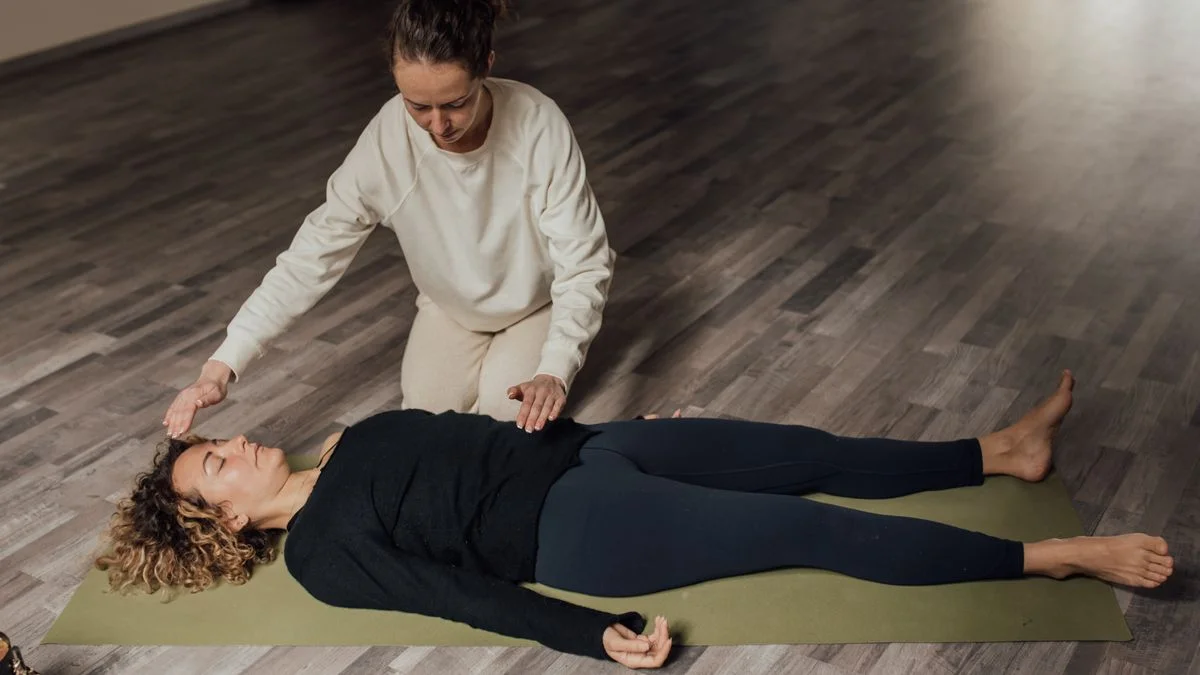
Body Scan Meditation for Sleep: A Step-by-Step Guide
The full sequence, feet-to-head versus head-to-feet, how long it should take, and why falling asleep halfway through is fine.